
Quick Answer:
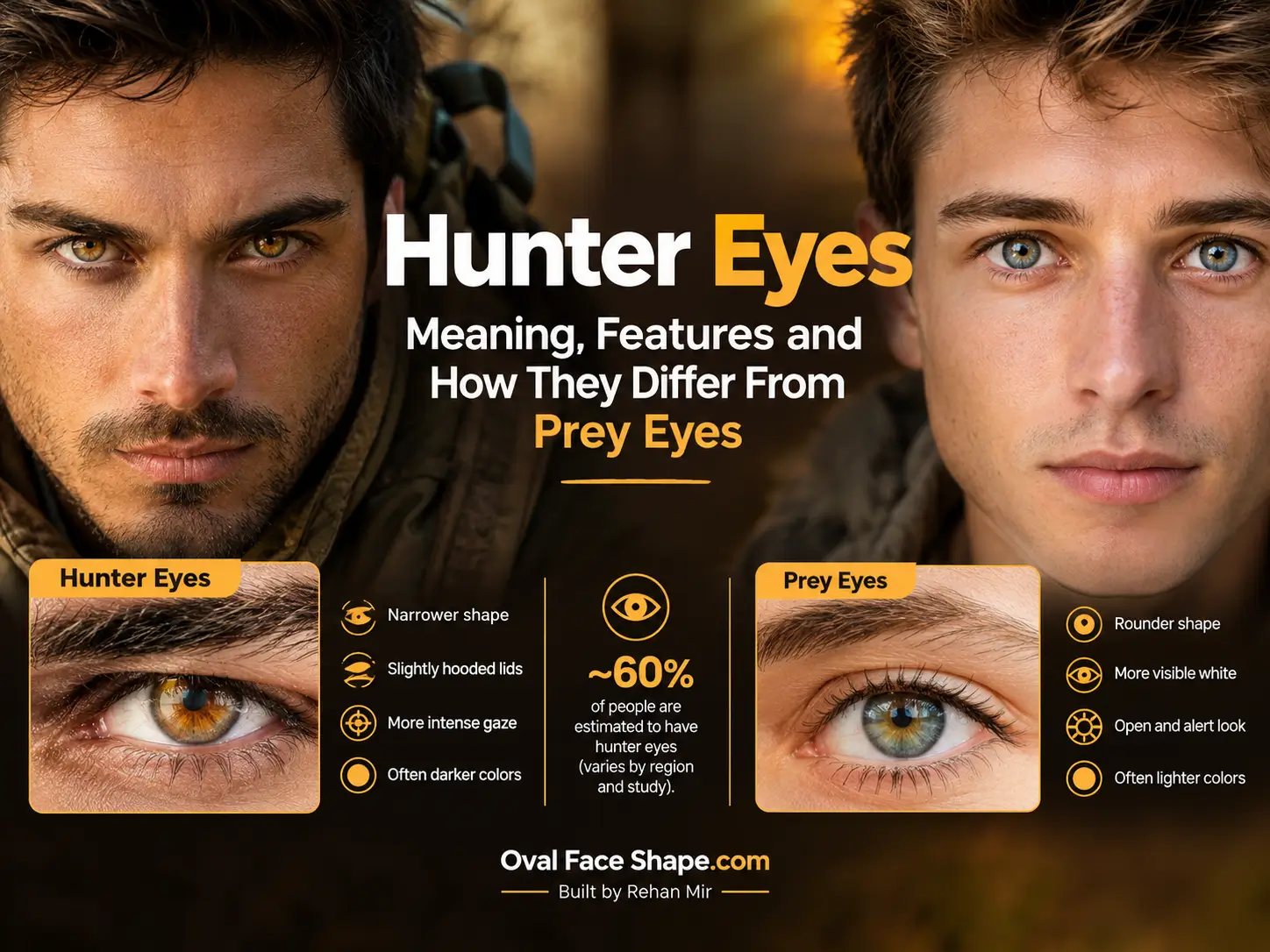
Hunter eyes are a perceived eye type characterized by deep-set, almond-shaped eyes, a positive canthal tilt, minimal upper-eyelid exposure, and little visible sclera below the iris.
By Muhammad Rehan Iqbal, Founder and Developer of OvalFaceShape.com, specializing in face shape analysis and interactive facial assessment tools.
Hunter eyes is an informal facial-aesthetics label, not a medical diagnosis or recognized anatomical category. It describes eyes that sit deep in the orbit and tilt upward at the outer corner, with little visible upper lid and little white showing around the iris.
Who this is for:
Readers who saw “hunter eyes” online and want to know what it means, whether they have them, and what can realistically change. This page covers the facial feature, not Bloodborne’s Blood Drunk Hunter or eye clinics in the Hunter region.
What Are Hunter Eyes?
The name borrows from animal biology. Predators such as lions and eagles have forward-facing eyes suited to depth perception, while prey animals such as zebras have side-set eyes for wide panoramic vision. Every human has forward-facing eyes, so the term is a metaphor about eye shape and expression, not about vision ability.
“Hunter’s eyes” and “hunter eye” mean the same thing. Prey eyes is the opposite descriptor.
Curious about the rarest eye shapes for different face shapes? Explore our complete guide to discover the key features, proportions, and characteristics behind them.
Hunter Eyes Features
- Positive canthal tilt: the outer corner (lateral canthus) sits higher than the inner corner (medial canthus).
- Minimal upper eyelid exposure: little lid skin shows when the eye is relaxed, giving a narrowed, focused look.
- Deep-set position: the eyes sit further back under the brow ridge, so the brow casts a shadow over them.
- Almond shape: the outer corner tapers instead of ending in a round curve.
- Little scleral show: minimal white is visible between the iris and the lower or upper lid.
- Short brow-to-lid distance: the brow sits close to the lash line.
Hunter Eyes vs Prey Eyes
| Feature | Hunter eyes | Prey eyes |
|---|---|---|
| Canthal tilt | Positive (upward) | Neutral or negative |
| Upper lid exposure | Minimal | More visible |
| Scleral show | Little or none | Visible below or above the iris |
| Eye shape | Almond, narrowed | Rounder, wider open |
| Set depth | Deeper | More prominent |
| Brow-to-lid distance | Short | Longer |
| Impression | Focused, intense | Open, soft |
Prey eyes vs hunter eyes is a spectrum, not a binary. Most people mix features from both columns.
Hunter eyes also overlap with two other terms. Hooded eyes have a skin fold that covers the lid crease, which can come from age. Deep-set eyes describe orbital depth. Hunter eyes need the upward tilt and low scleral show as well, so hooded or deep-set eyes alone don’t qualify.
Do I Have Hunter Eyes?
Use this five-step check:
- Take a straight-on photo at eye level, with a neutral expression, relaxed brows and even light.
- Draw a line through the inner and outer corner of each eye and compare it to a horizontal line. An outer corner higher than the inner means a positive tilt.
- Look for white between the iris and lower lid. Little or none points toward hunter eyes.
- Check the upper lid. Little visible lid skin points toward hunter eyes.
- Count the matches. Meeting most of them means you lean hunter, and meeting few means you lean prey.
Facial anthropometry, such as Farkas’s Anthropometry of the Head and Face, measures eye-fissure inclination, but natural variation is wide. No single angle separates “hunter” from “prey.”
Eye spacing is a separate proportion, covered in our eye spacing ratio guide. To see how your eye area fits your overall structure, run the Face Shape Detector.
Anatomy Behind the Look: Orbit, Lid and Age
Three things shape the look. The first is bone structure: Orbital depth and brow-ridge prominence are inherited. The second is eyelid structure: The crease, skin laxity and the connective tissue anchoring the outer corner. The third is age:
Age matters because upper lids lower over time. Surgery usually can correct the drooping eyelid in adults with age-related ptosis, per Harvard Health’s ptosis overview. Age-related hooding is not the same as hunter eyes, and a lid that droops suddenly needs prompt medical assessment.
Hunter Eyes in Men and Women
The structure is the same in both. The look is discussed more often for men because average brow-ridge prominence is higher, which deepens the shadow over the eye. In women, the same effect usually comes from a lifted outer corner, often styled with liner.
Brow and cheekbone structure also frame the eyes, as we explain in which face shape has high cheekbones, and the broader pattern sits in our cheekbones and face shape guide.
How to Get Hunter Eyes: What Works and What Doesn’t?
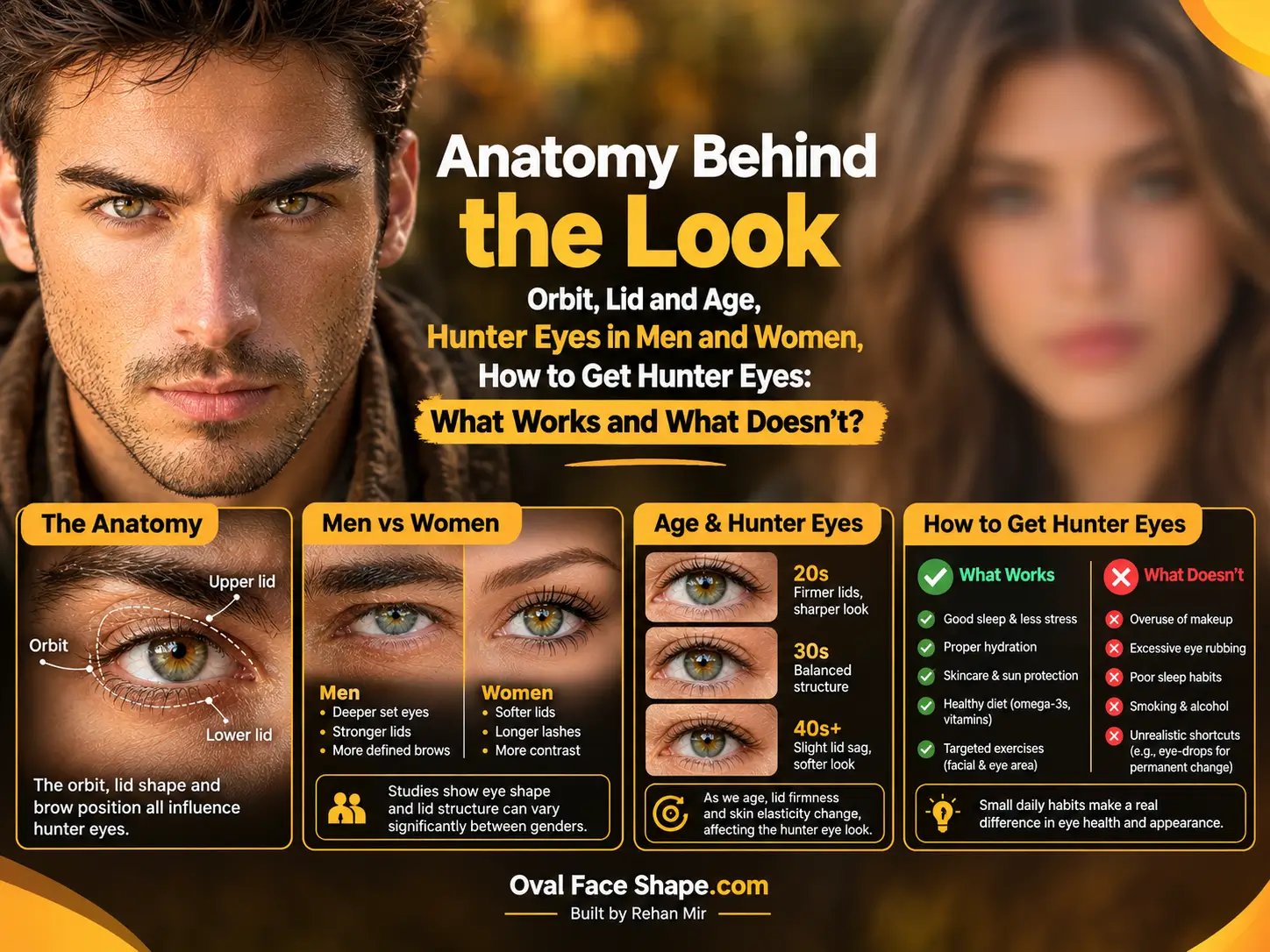
- Exercises: there is no established clinical evidence that eye or face exercises, or posture trends like mewing, change eyelid or orbital structure.
- Brows: a lower, straighter brow shortens the visible brow-to-lid distance.
- Liner: a slightly lifted outer line and shading along the lower lash line approximate tilt and depth.
- Surgery: eyelid and canthal procedures exist, but they carry risks such as dry eye, eyelid malposition and asymmetry. Consult a qualified oculoplastic or plastic surgeon before considering them.
Key Takeaways
- Hunter eyes is an informal label, not a diagnosis.
- Core markers are a positive canthal tilt, little upper lid, little scleral show and a deep-set almond shape.
- Prey eyes are the opposite, and most people sit between the two.
- Hooded and deep-set eyes are related but not identical.
- Structure is mostly inherited and ages with the lids. Exercises don’t change it, while brows and liner can approximate it.
FAQs
What does it mean to have hunter eyes?
It means your eyes show the aesthetic markers listed above: upward outer corners, minimal upper lid and little white around the iris. It describes appearance, not vision.
Are hunter eyes attractive?
Many people find them striking, especially in men, but attractiveness is subjective and culturally varied. No study establishes them as objectively more attractive.
What is the cause of hunter eyes?
Mostly inherited bone and eyelid structure: orbital depth, brow ridge and canthal position. Age can change lid position later.
Is hunter eye rare?
No reliable prevalence data exists, and the category has no formal definition, so any percentage you see online is unverified.
Get knowledge about the rarest eye shape in the entire world in our guide.
Are hunter eyes a scientific term?
No. Clinicians measure canthal tilt, eyelid position and scleral show, but “hunter eyes” is an online beauty label.
Are hunter eyes the same as hooded eyes?
No. Hooded eyes have a skin fold covering the crease. Hunter eyes also need a positive tilt and little scleral show.
Can hunter eyes change with age?
Yes. Upper lids lower with age, so a hunter-like look can shift toward hooding. Sudden drooping needs a medical check.
Next step:
Run the Face Shape Detector to see how your eye area fits your overall face structure.