
Quick Answer:
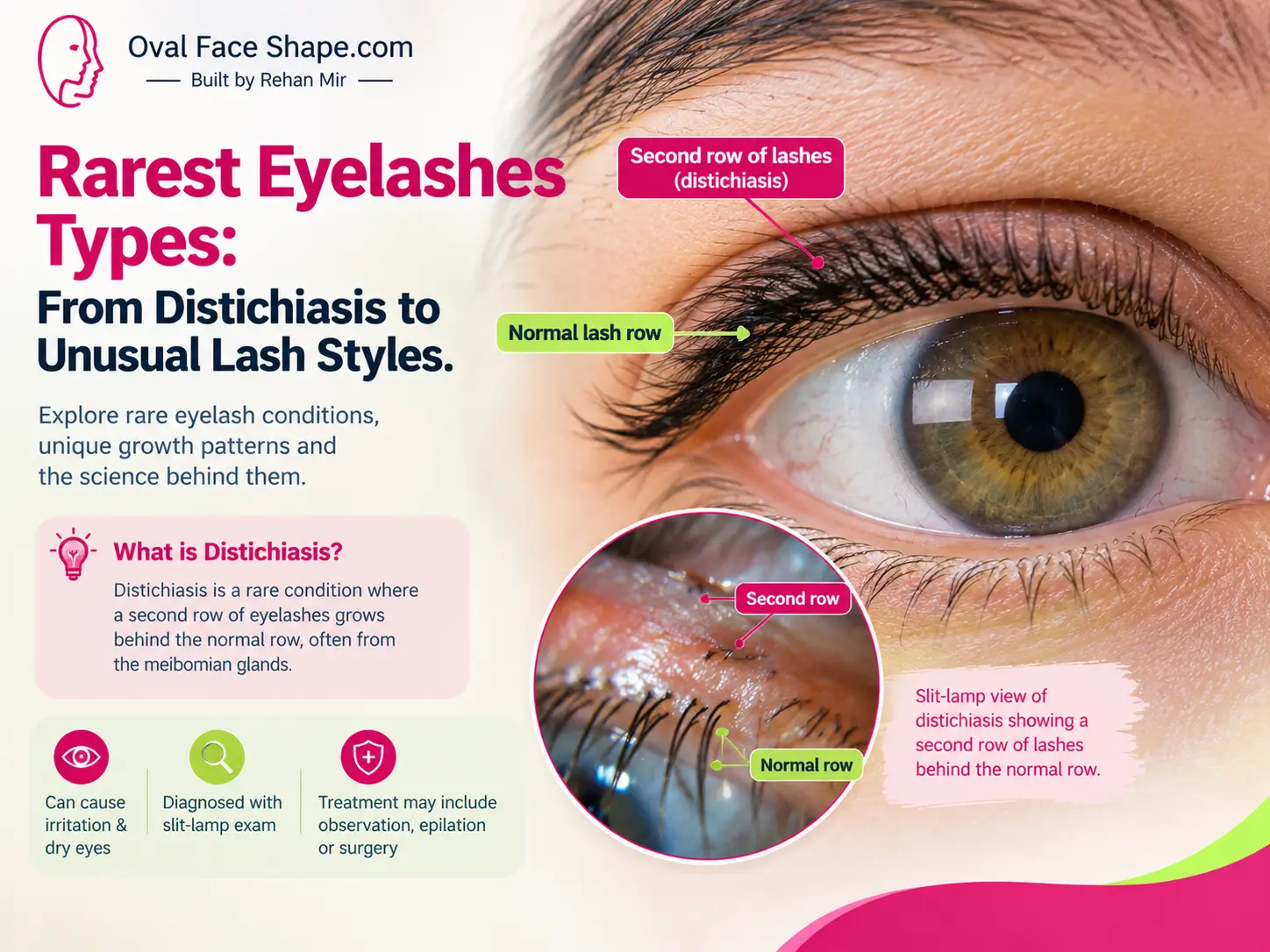
Distichiasis, a second row of eyelashes, is the best-documented rare eyelash type. No official rarity ranking exists; unusually long and white lashes are also uncommon.
By Muhammad Rehan Iqbal, Founder and Developer of OvalFaceShape.com.
The best-documented rare eyelash type is distichiasis: A second row of lashes growing behind the normal row. No official ranking exists, so “rare” here means medically uncommon.
Who this guide is for:
This guide from OvalFaceShape.com is for readers curious about unusual lashes, and for anyone decoding lash extension names before booking a set. It is general information, not medical advice.
Which Natural Eyelash Types Are Rare?
Three natural variations appear in medical literature as uncommon. No verified population-wide prevalence figure exists for any of them, so this guide does not rank them against each other.
| Natural type | What it looks like | Causes reported |
|---|---|---|
| Distichiasis | Extra row of lashes behind the normal row | Congenital (often FOXC2 gene) or acquired after lid injury or inflammation |
| Trichomegaly | Lashes 12 mm or longer, or unusually thick, curled or dark | Family trait, congenital syndromes, some drugs |
| Poliosis | Patch of grey or white lashes | Missing pigment |
Explore our guides to the rarest eye shapes and rarest eyebrow shapes to discover their defining features and unique characteristics.
Distichiasis (Double Eyelashes)
Distichiasis is a rare condition where the eyelid grows two rows of lashes. The second row can be one hair, a few hairs, or a full set, and it is often thinner or shorter than the first (WebMD).
The extra lashes emerge from the openings of the meibomian glands, the oil glands along the lid margin. A normal eyelid has only one row. uiowa
The congenital form is often linked to a FOXC2 gene mutation and to lymphedema-distichiasis syndrome, which pairs leg lymphedema with double lashes. In that syndrome, distichiasis appears in 94% to 100% of patients (NCBI case review). That figure describes people with the syndrome, not the general public.
Acquired distichiasis develops after lid injury or inflammation. Extra lashes can rub the eye surface and cause light sensitivity, so an eye doctor should assess them. Treatments include laser, cryotherapy, plucking and electrolysis. What Are Double Eyelashes?
Trichomegaly (Unusually Long Lashes)
Trichomegaly means lashes of 12 mm or more, or lashes that are unusually curled, pigmented or thick. Causes include congenital, familial, acquired and drug-related factors (Indian Journal of Dermatology review). nih
Glaucoma eye drops such as latanoprost, bimatoprost and travoprost are among the most commonly reported causes. Long lashes that turn inward can scratch the cornea, so eye symptoms need an exam. donovanmedicalnih
White Lashes (Poliosis)
Poliosis is a localized patch of grey or white hair caused by lack of pigment. Newly white lashes are worth an eye-doctor visit to rule out an underlying cause. entokey
Typical Natural Eyelash Structure
 The lower lid holds 75 to 80 lashes in three to four rows. The upper lid holds 90 to 160 across five to six rows (StatPearls).
A pulled lash takes about eight weeks to return, and a full lash cycle runs four to eleven months. In everyday beauty language, natural lashes are usually described as short and sparse, straight, or naturally curled.
Eyelash Extension Types and Styles
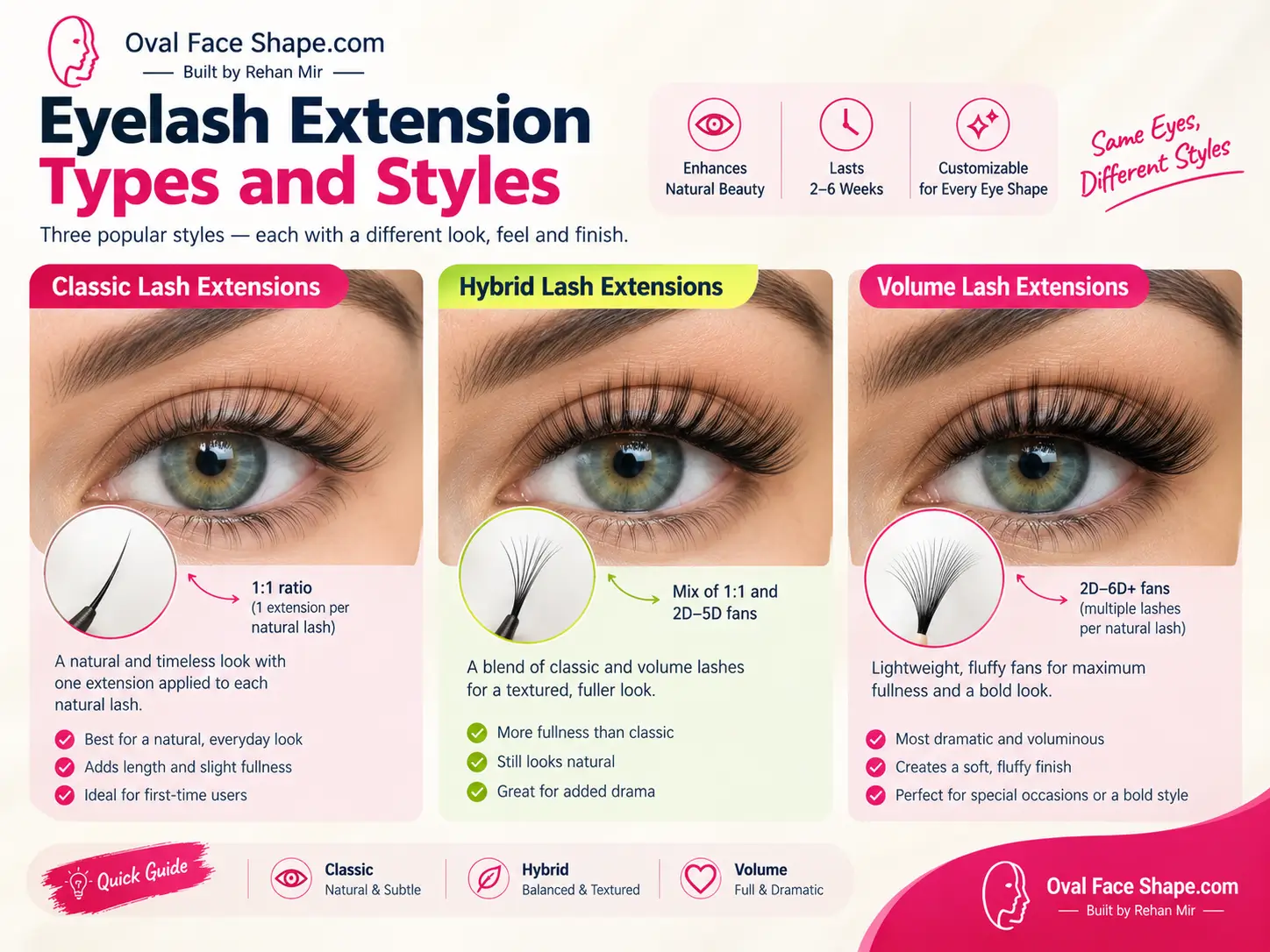
Extension “types” describe how many extensions sit on each natural lash. “Styles” describe where lengths sit along the eye, called the lash map.
| Type | Method | Look |
|---|---|---|
| Classic | One extension per natural lash (1:1) | Most natural, mascara-like |
| Hybrid | Classic singles mixed with small volume fans | Textured, balanced |
| Volume | 2D to 6D fans (two to six fine extensions per lash) | Fuller, softer |
| Mega volume (Russian volume) | 10D to 16D+ in one source; sources range from 6 to 20 | Maximum density |
| Wispy | Varied lengths and curls on a classic, hybrid or volume base | Feathery |
| Wet look | Closed, slightly clumped fans | Glossy, spiky |
Fan sizes vary by artist and brand. Volume and mega volume sets can be too heavy for fine or weak natural lashes.
Cat Eye and Doll Eye Lash Styles
Cat eye places longer lashes toward the outer corner and elongates the eye. Doll eye puts length near the center and opens the eye. Sources pair cat eye with round or prominent eyes and doll eye with narrow or hooded eyes.
A face-analysis workflow starts from measured proportions rather than trends, and lash mapping follows the same logic: eye width, spacing and lid shape decide what looks balanced. The eye spacing ratio guide explains how to measure that spacing.
Natural-Looking Eyelash Extensions
Classic or light hybrid sets in C or CC curls are the usual everyday choice. Ask the lash artist for a lash map, not just a style name, because labels differ between salons. Readers who want no extensions can use the ghost-lash approach covered in the FAQ below. lashlybeauty
False Lash Types and Lash Clusters
Five main false lash types exist: magnetic, strip, individual, cluster, and DIY extensions. Cluster lashes are small pre-made bundles that add volume faster than individual lashes. modelrocklashes
What Is Cumbrella?
“Cumbrella lashes” has no standard definition in the lash-industry or medical sources checked. Pages that mention it contradict each other: one describes a pre-arranged band between strip and individual lashes, while others treat Cumbrella as a brand name. Treat the term as unverified, and ask the artist or seller for photos and construction details before booking or buying.
Key Takeaways
- Distichiasis is the best-documented rare eyelash type; no official rarity ranking exists.
- Unusually long (trichomegaly) and white (poliosis) lashes are also uncommon and can signal an underlying cause.
- Classic, hybrid, volume, mega volume, wispy and wet look describe extension technique; cat eye and doll eye describe placement.
- “Cumbrella” has no verified standard definition, so ask for construction details.
- Persistent eye irritation from extra or inward lashes needs an eye doctor, not a lash artist.
Before choosing a lash map, see how your eyes sit within your overall proportions: run the Face Shape Detector.
FAQs
What is the rarest type of eyelashes?
Distichiasis, a second row of lashes, is the best-documented rare type. No source ranks all lash variations by rarity, and no reliable prevalence figures exist for distichiasis, trichomegaly or poliosis, so “rarest” cannot be proven.
What are the prettiest eyelashes ever?
No objective ranking exists, because lash beauty is subjective. In practice, lashes look best when length and density suit the eye: cat eye for round eyes, doll eye for narrow or hooded eyes.
Which type of eyelashes are best?
It depends on the goal. Classic suits a natural look, hybrid gives texture, and volume or mega volume gives fullness. Fine or weak natural lashes usually do better with a lighter set.
What are ghost eye lashes?
Ghost lashes are barely-there natural lashes worn with little or no visible mascara. They are usually curled and sometimes held with clear gel, a tint or a light brown mascara. This is a makeup approach, not a lash condition or an extension type. wmagazineinquirer
Do double eyelashes always mean a health condition?
Not always. Hereditary distichiasis without lymphedema is possible but extremely rare, and a family has been reported with it. Because congenital double lashes often belong to lymphedema-distichiasis syndrome, ask an eye doctor whether further evaluation is needed. healthlineijbs
What is the difference between distichiasis and trichiasis?
Distichiasis is an extra row of lashes. Trichiasis is normally placed lashes that grow inward, usually after lid scarring. Both can irritate the cornea. statpearls
How does natural lash growth affect lash extensions?
Extensions attach to natural lashes, so they leave when the host lash sheds. Natural lashes cycle over four to eleven months, and a pulled lash needs about eight weeks to regrow. nih
About the author:
Muhammad Rehan Iqbal is the Founder and Developer of OvalFaceShape.com, specializing in face shape analysis, interactive facial assessment tools, and educational styling guides. He combines web development, SEO, and facial-analysis expertise to build accurate, user-friendly resources.