
Quick Answer:
Makeup for a golden ratio face works by balancing your facial thirds and eye-nose-lip spacing, not by reshaping your face: map brows, contour only where proportions run long or wide.
By Muhammad Rehan Iqbal, Founder and Developer of OvalFaceShape.com, specializing in face shape analysis, interactive facial assessment tools, and educational styling guides.
Makeup for golden ratio face proportions means using the classic 1:1.618 guide, plus facial thirds and brow mapping, to decide where contour, blush and liner go. It connects your golden ratio face, your face shape and your facial thirds, and it creates balance through placement rather than changing bone structure.
Who this is for:
Anyone who has already measured their face and now wants brush placement. To measure first, see golden ratio face proportions. Surgery and filler are out of scope here.
What “golden ratio” means for makeup?
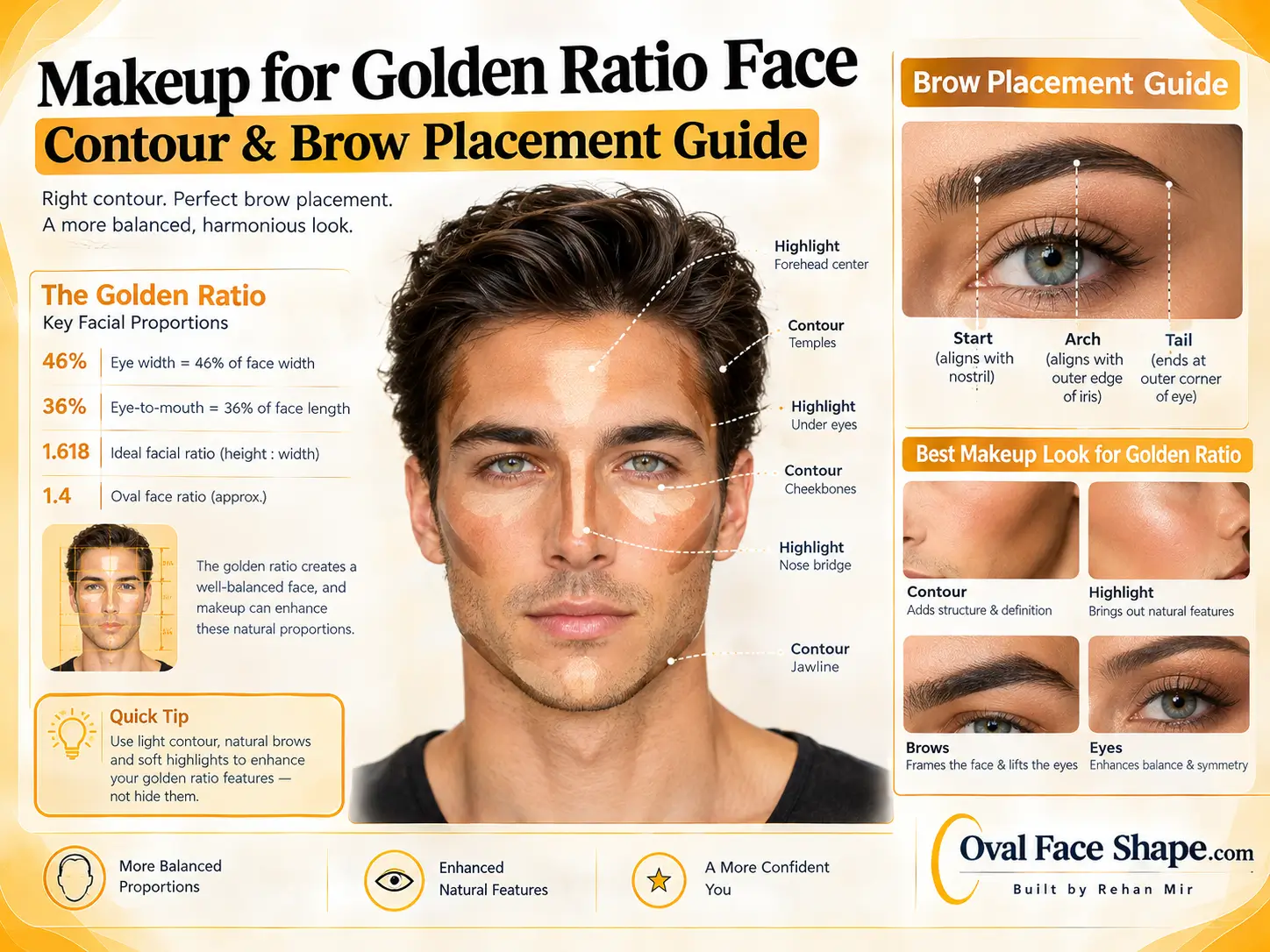
The golden ratio (phi, 1.618) is the classical benchmark, but the strongest perception research points elsewhere. In Pallett, Link and Lee (2010), attractiveness peaked when the eye-to-mouth distance was about 36% of face length and the distance between the eyes about 46% of face width.
Pallett said these are average distances rather than phi, and that male faces and other ethnic groups need further study.
Critics go further. Holland (2008) argued that Marquardt’s phi mask best describes masculinized white women seen as fashion models, so matching it is not a universal goal. One brow artist uses the ratio as a guide, not a hard rule.
In practice, use the ratio to spot which area reads long, short or wide, then correct that area softly.
Step 1: Find your facial thirds
The thirds run hairline to brows, brows to the base of the nose, and nose base to chin. Compare them in a straight-on, makeup-free photo.
| Third | If it reads large | If it reads small |
|---|---|---|
| Upper (hairline to brows) | Soft contour at the hairline edge | Keep the hairline clear; brighten the centre |
| Middle (brows to nose base) | Blush placed horizontally across the cheeks | Blush placed higher and more vertical |
| Lower (nose base to chin) | Light shade under the jaw | Highlight centre of chin and lips |
The cited sources back the forehead and blush rows. One makeup artist contours her forehead because it is bigger than her chin.
Perfect Corp’s thirds guidance suggests horizontal blush when the face reads too long and vertical blush when it reads too short. The remaining cells follow standard artist practice.
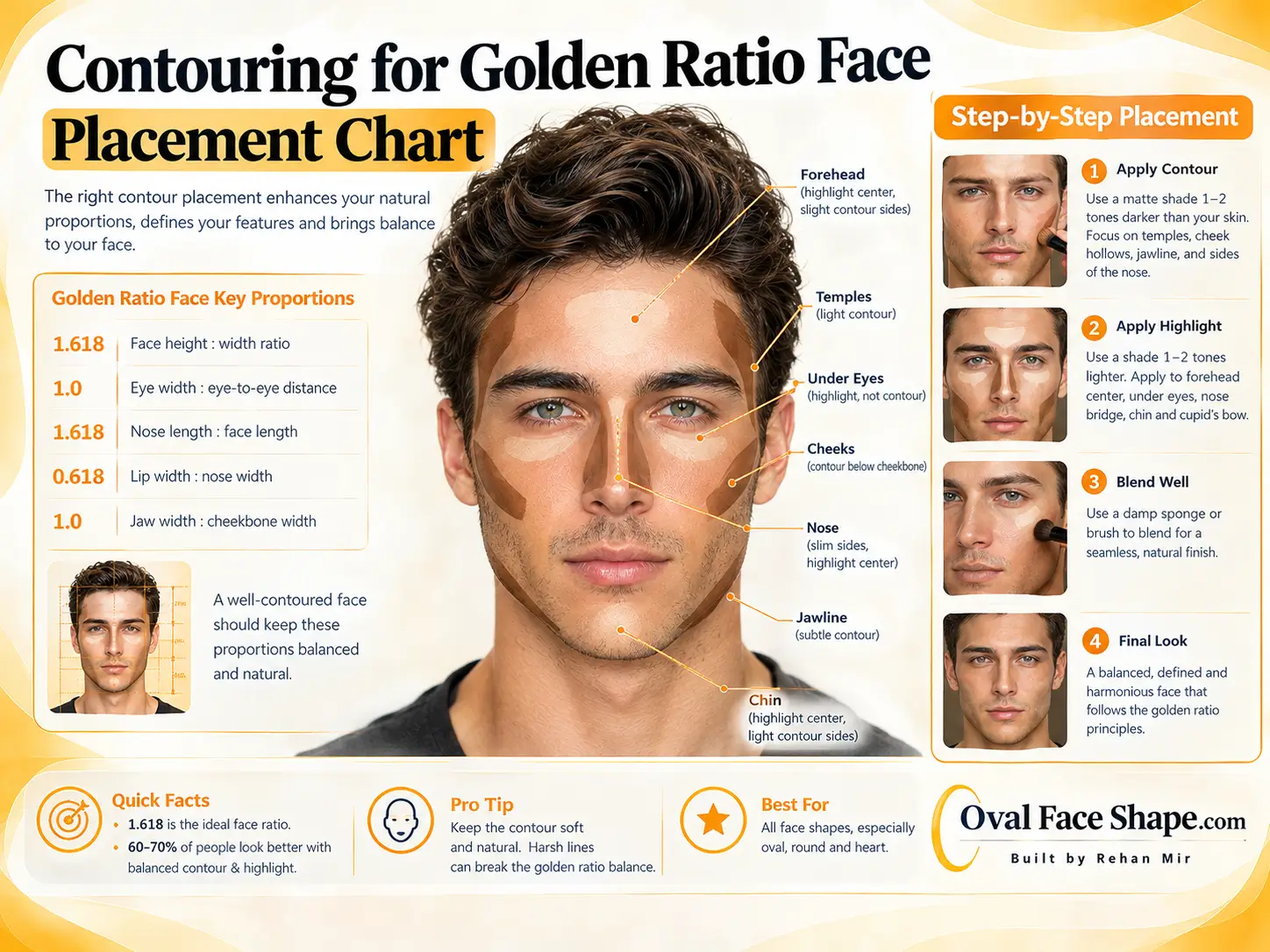
Contouring for Golden Ratio face: Placement chart
| Zone | Placement | Why |
|---|---|---|
| Forehead | Matte shade along the upper hairline, only if tall | Shortens the upper third |
| Cheekbones | Under the bone, from ear toward mid-cheek, blended up | Adds definition without dragging the face down |
| Nose | Minimal; a light touch only | The eyes, nose and lips are the centre zone that draws most attention. |
| Jaw and chin | Light shade under the jaw if long; chin highlight if short | Adjusts the lower third Substack |
Darker contour on Jennifer Lopez’s cheekbones is cited as balancing her diamond face shape. This shows that shape and proportions work together; for shape-based maps, use contouring for face shapes.
Golden Ratio Eyebrows: Map three points
Brow mapping fixes the start, arch and end. The start sits on a line from the nostril edge past the inner eye corner. The arch sits on a diagonal from the nostril through the pupil.
The tail sits on a diagonal from the nostril past the outer eye corner. Anastasia Beverly Hills patented its Golden Ratio brow method built on this idea.
| Point | Guide line |
|---|---|
| Start | Nostril edge to inner eye corner, straight up |
| Arch | Nostril through pupil or iris, diagonally |
| End | Nostril to outer eye corner, diagonally |
Use the three points as a map, then adjust for your nose and brow bone. For brow types, see rarest eyebrow shape.
Golden Ratio Eye makeup
The 46% benchmark above compares eye spacing with face width. If your eyes sit closer than that, lighten the inner corners and weight the outer lid.
If they sit wider, deepen the inner corners. This is standard artist practice rather than a tested protocol. A white or nude waterline liner is a common way to make eyes look brighter and bigger.
Makeup for golden ratio face, Korean style
I found no research tying Korean makeup trends to the golden ratio specifically. The overlap is practical: when the upper third is large, straight or upward brows with a lower brow front soften the look. Straighter, softer brows and blended contour suit that correction.
The male golden ratio face
Research on male ratios is still open (see Pallett above). For men, balance usually comes from grooming: clean brows along the same three points, and a matte shade only where the jaw or forehead needs it.
Golden ratio face glam: the finish
One makeup educator suggests lifting blush slightly higher on the cheek and angling it inward, and skipping a full-face triangle of concealer. Highlight the centre zone last so light lands on the eyes, nose bridge and lips.
Common mistakes
- Treating 1.618 as a pass/fail score.
- Contouring the whole face instead of the one third that reads off.
- Copying a celebrity “golden ratio” map without checking your own thirds; celebrities with golden ratio faces are examples, not templates.
Key Takeaways
- Use ratios to find where to adjust, not to chase a score.
- Research favours average-face targets (36% and 46%) over phi, and those findings come from female faces.
- Map brows at three points, then adjust to your features.
- Contour only the third that runs long or wide.
- Face shape and proportions work together.
FAQs
What is the perfect golden ratio for a face?
The classical answer is 1.618 (phi). Research found a different target: attractiveness peaked near an eye-to-mouth distance of 36% of face length and an eye spacing of 46% of face width. Those results came from female faces, so treat them as guides.
Calculate your Golden Ratio Face Score with our Golden Ratio Face Detector to explore your facial proportions and see how they compare with the mathematical golden ratio.
Does golden ratio makeup change my face proportions?
No. Makeup shifts where light and shadow fall, which changes what the eye notices. Bone structure stays the same.
Is golden ratio makeup still worth using?
Yes, as a starting map. Critics show that phi-based masks are not universal, so check results against your own face rather than trusting a score.
Golden ratio makeup or face shape makeup: which first?
Face shape describes your outline, and the ratio describes spacing and thirds. Start with your shape for contour lines, then use thirds to fine-tune.
Do I need a golden ratio calculator?
No; a straight-on photo and a ruler are enough. Calculators depend on accurate landmark placement, and small errors change the result.
Does it work for men and different skin tones?
The placement logic is the same, but the research caveat applies: other groups and male faces need more study. Match shades to your undertone.
Next step:
Not sure whether your contour should follow your face shape or your thirds? Run the Face Shape Detector first, then apply the placements above.