
Quick Answer:
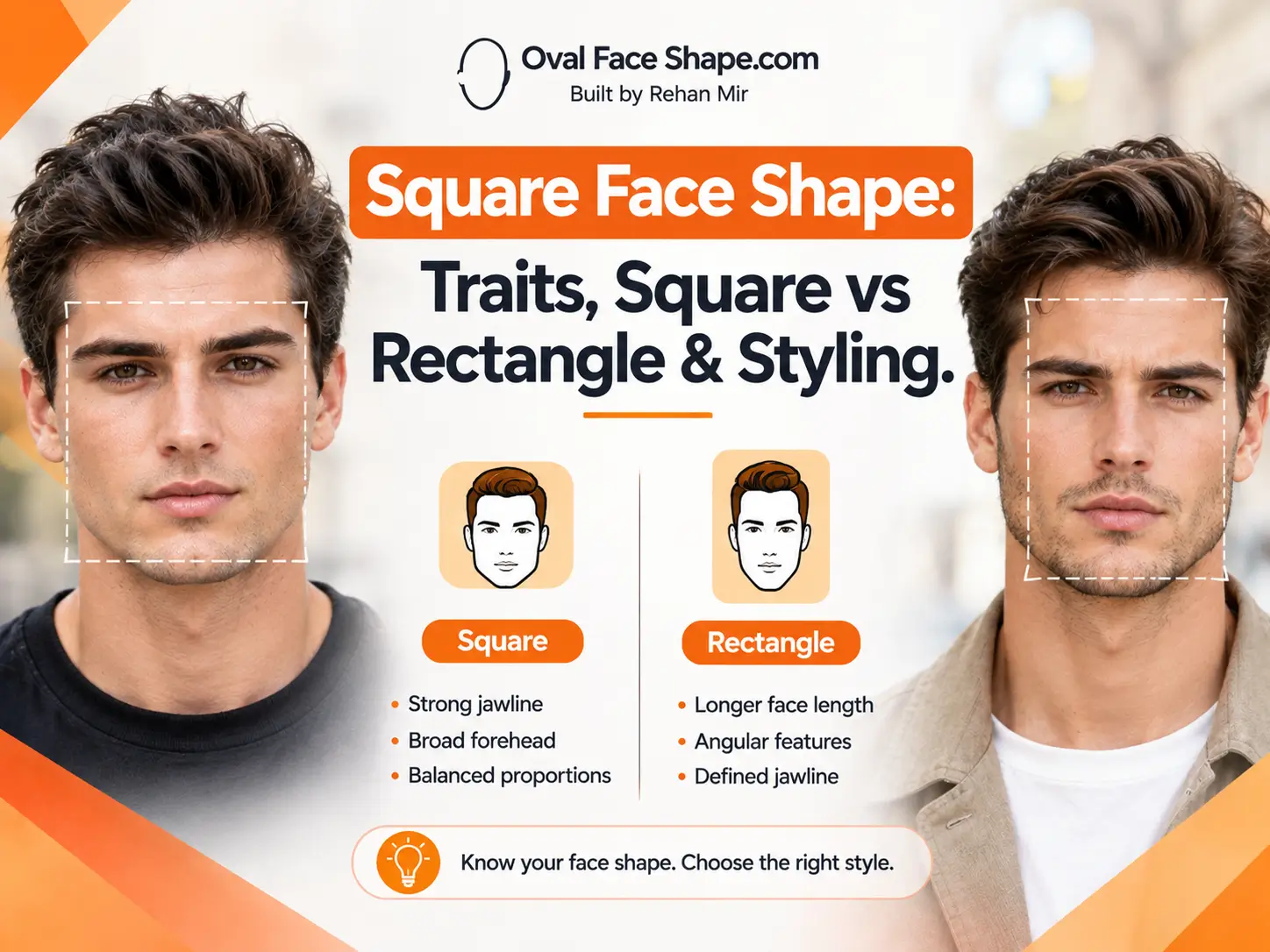
A square face shape has a forehead, cheekbones, and jawline of roughly equal width, a length close to its width, and a strong, angular jaw. It is most often confused with a rectangle.
If you’re trying to work out whether your face is square before you commit to a haircut or a new pair of glasses, this guide gets you there in two steps: confirm the shape, then style it.
On OvalFaceShape.com, the fastest way to confirm it is the Face Shape Detector, but the self-check below works just as well with a mirror and a tape measure.
How square face shape look?
A square face is defined by three widths — forehead, cheekbones, and jaw — sitting close together, combined with a face length that’s close to that width, and a jawline that turns a visible corner instead of curving softly into the chin.
What Defines a Square Face Shape?
- Forehead, cheekbone, and jaw width are all similar — no single zone dominates.
- Face length is close to face width — a compact, roughly 1:1 to 1.2:1 ratio.
- Jaw corners are angular and visible, not rounded.
- Cheek-to-jaw taper is minimal — the sides run fairly straight down.
Anthropometrists formalize this with the facial index:
Vertical face height divided by bizygomatic (cheekbone) width, multiplied by 100.
A square face sits toward the “broad and short” end of that scale, a method that’s been in continuous clinical use since the early twentieth century using the 4-point measurement system from craniofacial anthropometry research (Farkas LG, Anthropometry of the Head and Face, 2nd ed., Raven Press, 1994; WorldCat record).
How to Tell If You Have a Square Face?
Work through this in order — each step should agree before you call it square.
- Measure forehead width — the widest point, roughly halfway between your eyebrows and hairline.
- Measure cheekbone width — straight across the top of each cheekbone.
- Measure jaw width — from below one ear to the chin tip, doubled.
- Measure face length — hairline center to chin tip.
- Compare the three widths. Close together (within about a centimeter or two)? Continue.
- Compare length to width. Roughly equal? Continue.
- Trace your jawline with a finger. A distinct corner below the ear means square; a smooth curve means round instead.
If all seven checks line up, you have a square face. If the widths match but your face is clearly longer than it is wide, you’re more likely looking at a rectangle face shape, not square — that’s the single most common mix-up in self-diagnosis.
Square vs. Every Other Face Shape
| Shape | Widest area | Jaw | Length vs. width |
|---|---|---|---|
| Square | Forehead ≈ cheekbones ≈ jaw | Angular, defined corners | Roughly equal |
| Rectangle | Forehead ≈ cheekbones ≈ jaw | Angular, similar to square | Noticeably longer than wide |
| Round | Cheekbones | Soft, curved, no corners | Roughly equal |
| Oval | Cheekbones | Gently tapered | Longer than wide |
| Diamond | Cheekbones (clearly widest) | Narrow | Longer than wide |
| Heart | Forehead | Narrow, pointed chin | Longer than wide |
| Triangle | Jaw (widest of the three zones) | Wide, dominant | Roughly equal to longer |
Soft Square vs. Oval-Square: Where the Lines Blur?
Many faces sit between categories. A soft square face has the roughly equal forehead, cheekbone and jaw widths of a square face, but the jaw corners are rounded instead of sharply angled. An oval-square face keeps a fairly angular jaw but is slightly longer than it is wide, so its length-to-width ratio sits between square (up to about 1.15) and oval (about 1.3 to 1.5).
If your jaw corners are visible but not sharp, and your face is only a little longer than wide, you’re probably in this overlap. The square-face styling advice above still applies: soft layers, waves and textured fringe. These labels are styling heuristics, not strict categories, so borderline results are normal.
The two shapes people confuse square with most:
Round (same compact ratio, but soft jaw) and Diamond (cheekbones clearly stand out wider than forehead and jaw, unlike square’s balanced three widths).
Common Misconceptions
- “A square jaw is a flaw to hide.” It isn’t — a defined jaw reads as structured and photogenic, and stylists routinely contour softer faces to imitate it.
- “Square and rectangle are the same shape.” They share the angular jaw and even widths; length is what separates them.
- “Square faces can’t wear angular glasses or short hair.” They can — the styling notes below are trade-offs, not hard rules.
Best Hairstyles for a Square Face
The general goal is to add curves and a little length without hiding the jaw.
For women:
Soft waves, layered cuts that fall past the jawline, and side-swept bangs introduce movement that balances straight edges. A blunt bob ending right at the jaw does the opposite — it draws a hard line across the widest part of the face.
For men:
A textured crop with height on top, a side part, or loose waves soften the jaw’s rigidity; volume up top elongates a compact face. For a full length-by-length breakdown;
See the site’s Square Face Shape Hairstyle Male guide.
Best Glasses for a Square Face
Curved frames are the near-universal recommendation, since they contrast directly with the jaw’s angles.
- Round frames — the top pick; pure curves against pure angles.
- Oval frames — similar softening effect, more everyday versatility.
- Rimless or thin frames — minimal structure, lets the bone structure lead.
- Avoid boxy square or rectangular frames — they stack a second set of hard corners onto an already angular face.
Full frame-by-frame picks: Glasses by Face Shape.
Beard Styles for a Square Jaw
A fuller beard at the chin with sides tapered close to the jawline creates a subtle rounding effect, and curved eyewear (aviators, round sunglasses) reinforces the same balance. Sharp, boxed beard lines do the opposite — they emphasize the jaw rather than soften it, which is a fine choice if that’s the look you want.
Full styling breakdown: Beard Styles by Face Shape.
Curious which beard styles suit a square jaw? Read our comprehensive guide to Beard Styles for a Square Jaw and discover styles that complement your face shape.
Square Face Shape Celebrities
Among women, Zendaya, Jennifer Aniston, Margot Robbie, Angelina Jolie, and Olivia Wilde are frequently cited for a forehead and cheekbones of similar width paired with a defined jawline.
Among men, Pedro Pascal, Michael B. Jordan, Brad Pitt, and Henry Cavill are commonly listed as square-face examples. These are widely published visual attributions, not exact measurements.
See our comprehensive guide for Celebrity Face Shapes for more.
Is a Square Jaw Permanent?
Jaw width is largely set by underlying bone structure at the mandibular angle, so it doesn’t shift much with everyday weight changes the way cheek fullness does.
A study adjusting for body size across more than 6,000 men and women found facial width remained strongly associated with sex even after controlling for height and weight Research adjusting for body size across a sample of more than 6,000 men and women found that facial width remains strongly associated with sex even after controlling for height and weight (ScienceDirect).
One reason square jaws are reported more often in men, though plenty of women share the trait. For people who want a softer look without surgery, masseter Botox is the most common non-surgical option, reducing jaw muscle bulk rather than bone width. ovalfaceshape
Key Takeaways
- A square face has near-equal forehead, cheekbone, and jaw width, a length close to its width, and angular jaw corners.
- The most common mix-up is rectangle — same even widths, but noticeably longer.
- Diamond is the other frequent confusion — cheekbones there are clearly the widest zone, unlike square’s balance.
- Curves in hair, glasses, and beard styling soften the jaw; none of it is mandatory.
- The underlying bone structure is stable through weight changes; masseter Botox is the main non-surgical softening option.
FAQs
Is a square face shape attractive?
Yes — a defined jawline is widely regarded as a strong, photogenic feature, and several well-known actors are frequently cited as square-face examples. Attractiveness research generally points to symmetry and proportion rather than any single “ideal” shape.
What’s the difference between a square and a rectangle face shape?
Both have angular jaws and near-equal forehead, cheekbone, and jaw width. The difference is length: square is roughly as long as it is wide; rectangle is noticeably longer.
Is a square face shape rare?
It’s a moderately common shape, more often reported in men. Exact prevalence figures vary across studies and detection tools, since most published percentages come from self-selected app users rather than a random population sample — treat any single number as indicative, not definitive.
What hairstyle is best for a square face shape?
Soft waves, layered cuts, and styles with movement near the jaw balance the angles without hiding your strongest feature. Blunt, straight-across cuts ending at the jaw tend to emphasize it instead.
Can you change a square jawline without surgery?
Not the underlying bone width — but the appearance can be softened. Masseter Botox reduces jaw muscle bulk, and hairstyles or glasses with curves visually balance the angles.
Why do face-shape quizzes and AI apps sometimes give me a different result?
Square and rectangle borderline faces are the most common source of disagreement between tools. Landmark-based detectors tend to be more consistent than simple rule-of-thumb quizzes, so comparing a tool’s result against the manual self-check above is the most reliable approach.
6 thoughts on “Square Face Shape: Traits, Square vs Rectangle & Styling”