
Table of Contents
ToggleQuick Answer:
Add length to round faces, width to rectangular faces, and fullness to the chin for heart and diamond faces. Keep square and triangle beards close to the jaw. Oval faces suit almost any beard.
The best beard for your face shape adds what the face lacks and downplays what it already has: length for round faces, width for rectangle faces, chin weight for heart and diamond faces, and a close-trimmed jaw for square and triangle faces. Oval faces can wear nearly any style.
Who this is for:
Men choosing a beard before growing one or before a barber visit, and barbers who want a quick shape-to-style reference. This guide covers beard styling only. To measure a face shape from scratch, start with the steps below.
Curious about the best hairstyles for your face shape? Explore our complete guide to hairstyles for every face shape and find styles that suit your features.
How to Find the Beard Style for Your Face Shape?
- Identify your shape. Compare four measurements: forehead width, cheekbone width, jawline width, and face length. These are standard landmark measurements from craniofacial anthropometry (Farkas, Anthropometry of the Head and Face, 1994). Or run a photo through OvalFaceShape.com’s Face Shape Detector.
- Name the goal. Round and square faces need length or softer angles, rectangle faces need width, heart and diamond faces need chin fullness.
- Start short. Stubble or a short boxed beard shows how a style sits on your jaw before you commit to months of growth.
Why Face Shape Decides Beard Style?
A beard changes the apparent width and length of the lower face, so it works as optical balancing. Barbers use the same logic when pairing haircuts to face shapes.
Beard density also changes how a face reads. In one study of female raters, full beards scored highest for masculinity and age, while light stubble scored highest for attractiveness (Neave and Shields, 2008). That is one reason stubble is a safe first test.
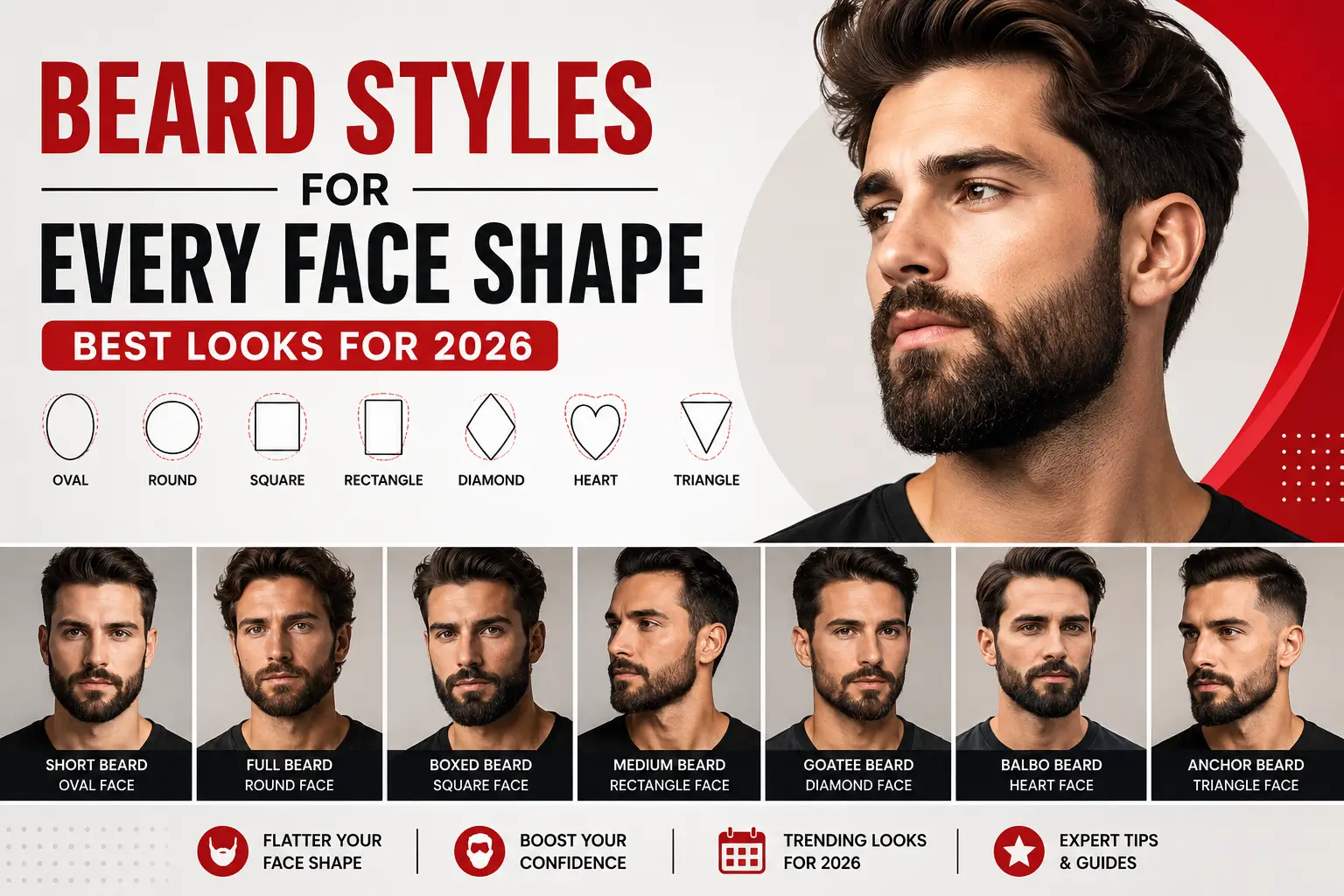
Quick Reference: Beard Styles by Face Shape
| Face shape | Goal | Best styles | Simplest short option | Avoid |
|---|---|---|---|---|
| Oval | Keep balance | Stubble, boxed beard, full beard | Light stubble | Untidy neckline |
| Round | Add length and an angle | Anchor, Van Dyke, pointed goatee | Chin strap | Wide, rounded beards |
| Square | Show or soften the jaw | Short boxed beard, circle beard | Light stubble | Long, jaw-hiding beards |
| Rectangle | Add width | Full beard with fuller sides | Wide stubble | Long, pointed beards |
| Heart | Build the chin | Extended goatee, anchor | Short goatee | Bulk at the cheeks |
| Diamond | Soften cheeks, fill chin | Balbo, corporate beard | Goatee with chin coverage | Tight cheeks, bare chin |
| Triangle | Limit jaw width | Close-trimmed beard | Light stubble | Full, wide beards |
Oval Face: Beard Styles That Work
Oval faces are balanced, with face length roughly 1.3 to 1.5 times the cheekbone width and a gently rounded jaw. Nothing needs correcting, so stubble, short boxed beards, and full beards all work. Keep the neckline and cheek lines clean so the natural balance holds.
Beard Styles for a Round Face
Round faces have similar width and length, soft edges, and no strong jaw angle. Styles that are longer at the chin and tapered at the sides, such as an anchor beard, Van Dyke, or pointed goatee, create the length and angle the face lacks.
Robert Downey Jr.’s goatee-and-mustache as Tony Stark is a well-known example of chin-focused styling.Thick sideburns and rounded full beards add width to the cheeks, which is the wrong direction.
Beard Styles for a Square Face
Square faces have a strong jaw, and forehead, cheekbone, and jaw widths are close. Two goals are valid here. To showcase the jaw, keep a short boxed beard or stubble that follows its line.
To soften the angles, choose a circle beard, which is fuller at the chin and rounder at the corners.Long beards hide the jawline, which defeats the first goal.
See the square face shape guide for how this shape is measured, also get the beard styles for a square jaw.
Beard Styles for a Rectangle Face
Rectangle faces, also called oblong, are longer than they are wide, with a fairly straight jaw. The goal is width over length. A full beard with fuller sides adds width, and Keanu Reeves’ fuller beard is often cited as an example. Chin straps and long pointed beards stretch the face vertically.
Unsure whether you are rectangle or oval? Read oval vs oblong face shape.
Beard Styles for a Heart Face
Heart faces have a wide forehead tapering to a narrow chin. The chin is the underbuilt feature, so an extended goatee, anchor beard, or full beard with extra chin length brings the lower face into proportion. Keep the cheeks trimmed, since width there exaggerates the taper.
Beard Styles for a Diamond Face
Diamond faces are widest at the cheekbones, with a narrower forehead and pointed chin. A Balbo or corporate beard softens the cheek width while adding substance at the chin. A beard cut tight to the cheeks with a bare chin leaves the point exposed.
Beard Styles for a Triangle Face
Triangle faces have a jaw wider than the cheekbones and a narrower forehead. Guides disagree here: some recommend a full beard to balance the face, others a short one. This guide favors close trimming, because volume at the widest point adds to it. Test with light stubble first.
Can AI Tell You Which Beard Style Suits You?
AI tools do two different jobs. A face shape detector classifies your shape from facial landmarks, which answers the “beard face shape test online” question. Beard try-on filters render a chosen style onto your photo.
OvalFaceShape.com’s Face Shape Detector does the first job only. Neither tool can predict how your beard will actually grow, so treat any preview as a target to show your barber.
Common Mistakes
- Copying a style from social media without checking your proportions
- Letting neckline and cheek lines go untrimmed
- Treating “full beard” as one style, when length and shaping change the effect
Key Takeaways
- Beard styling adds what a face shape lacks and downplays what it has in excess.
- Oval faces suit nearly any style; round, rectangle, and triangle faces gain most from a shape-specific choice.
- Short styles like stubble are the safest way to test before growing a full beard.
- Clean lines matter as much as the style itself.
FAQs
Is a beard good for a round face?
Yes, if it adds length rather than width. An anchor beard or pointed goatee elongates a round face, while a full rounded beard widens it.
Does beard style still matter in 2026, or is any beard fine?
It still matters. Matching a beard to face shape is a proportion principle, not a passing trend.
Rectangle face vs. oval face: does the beard advice change?
Yes. Oval faces suit almost any style, while rectangle faces need width and should avoid long pointed beards.
Can a beard change my face shape?
Not your bone structure, but it changes the apparent proportions of your lower face, which is why the match matters.
Which beard suits me if I can’t grow a full one?
Choose shorter, sharply lined styles such as stubble or a short boxed beard. Growth pattern varies by person, so keep the length where the coverage looks even.
How long should I grow a beard before deciding on a style?
Give it two to three weeks at stubble length. Growth speed varies, so judge the shape rather than the calendar.
Next step:
Confirm your shape with the Face Shape Detector, then use your shape’s row in the table above.