
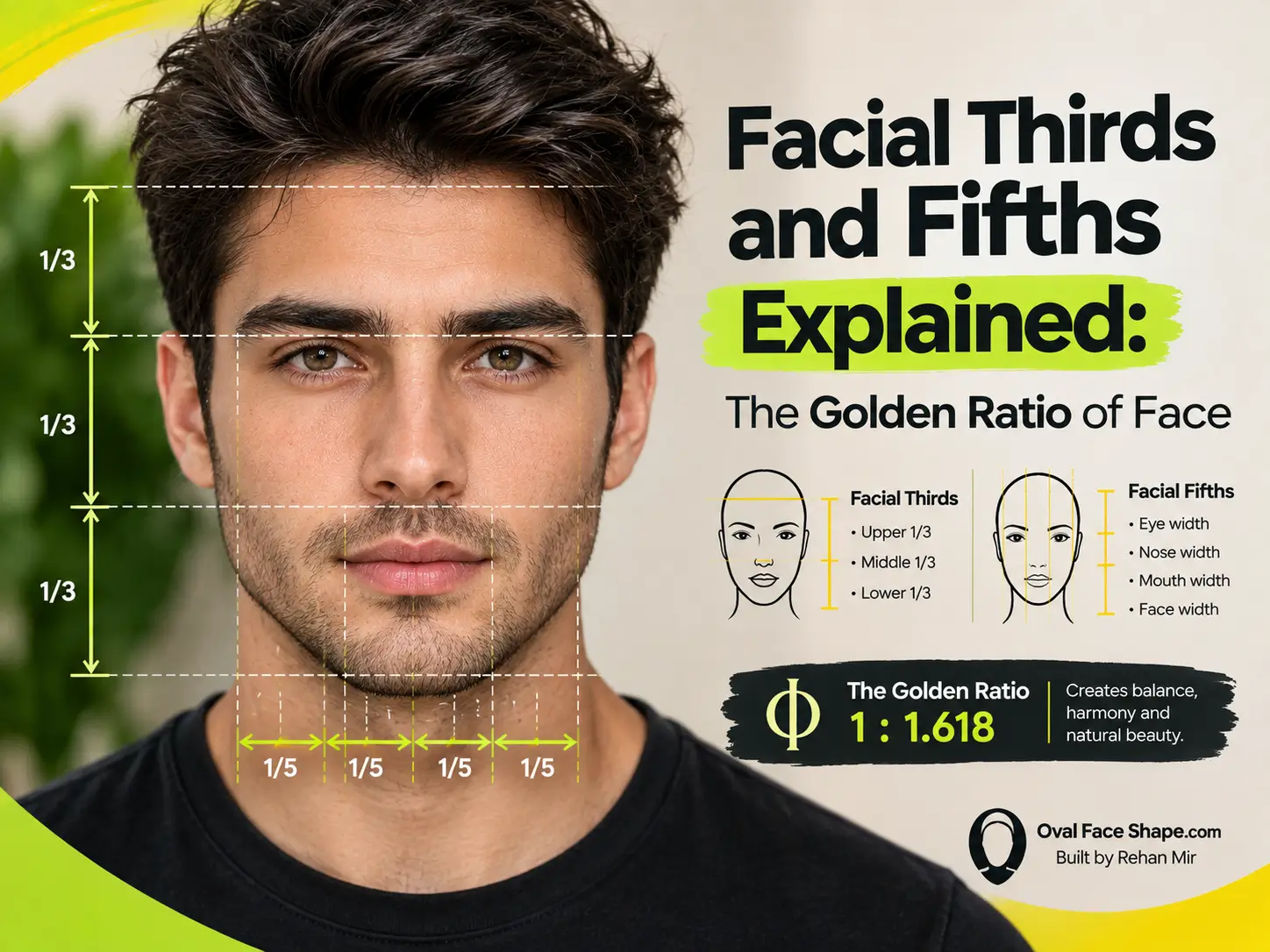
Quick Answer:
Facial thirds and fifths are guidelines for evaluating facial proportions and balance. Facial thirds divide the face horizontally into three sections, while facial fifths divide it vertically into five approximately equal sections, each about one eye-width wide.
Facial proportion talk is everywhere right now — golden ratio calculators, “beauty score” apps, side-by-side celebrity overlays. Two of the oldest and most-cited systems behind all of it are facial thirds and facial fifths.
If you’ve wondered what these terms actually mean, whether your own face is supposed to match them, or how they relate to the golden ratio you keep seeing quoted, This guide breaks down both systems in plain language — and where each one holds up under real scrutiny.
For who is this guide for written:
This is written for anyone curious about their own facial proportions before running a beauty calculator, plus barbers, stylists, and portrait photographers who want the correct vocabulary.
It won’t re-explain full face-shape classification — for that, OvalFaceShape.com’s Types of Face Shapes guide covers oval, round, square, and the rest in depth.
What Are Facial Thirds?
Facial thirds divide the face into three horizontal zones, measured from the hairline to the chin. The idea traces back to Vitruvius and was later repeated by Leonardo da Vinci in his anatomical sketches — it’s a drawing convention first, and a measurement second.
- Upper third: trichion (hairline) to glabella (the smooth point between the eyebrows)
- Middle third: glabella to subnasale (base of the nose)
- Lower third: subnasale to menton (bottom of the chin), which itself splits again — the upper lip typically accounts for roughly a third of this zone, and the lower lip plus chin the remaining two-thirds
When the three zones sit close to equal, a face is generally read as vertically balanced. A visibly longer lower third or shorter middle third is what most people mean when they say a face looks “off” without being able to name why.
What Are Facial Fifths?
Facial fifths work the same idea sideways. The face is divided into five vertical columns, each roughly one eye-width across, using the inner and outer canthi (eye corners) and the alar base (the outer edge of each nostril) as landmarks.
In an “ideal” layout, the central fifth sits between the inner corners of the eyes and roughly matches the width of the nose, with two more eye-widths extending out to each ear.
This is the horizontal counterpart to thirds: Thirds check vertical balance (is the forehead proportionate to the jaw), while fifths check horizontal balance (are the eyes and nose evenly spaced across the face).
Where These Rules Actually Come From?
Neither system was derived from measuring thousands of real faces and averaging the results. The thirds canon comes from classical sculpture and Renaissance drawing instruction; The fifths convention was formalized later by Neoclassical artists using eye-width as a natural, scale-free unit.
Clinicians — particularly in orthognathic surgery and rhinoplasty planning — adopted both as a rough diagnostic shorthand (Powell & Naini, 2011), not because real faces reliably match them.
That distinction matters: A ratio needs no scale to check, which is exactly why it survived as a teaching tool for 2,500 years. But “useful teaching shorthand” and “population average” are two different claims, and most of the content repeating these rules online blurs the two.
How to Measure Your Own Facial Thirds and Fifths?
- Take a straight-on photo at eye level, with a neutral expression and hair off your face.
- For thirds: mark your hairline, brow line, base of your nose, and chin. Compare the three gaps — anything within roughly 5% is indistinguishable by eye.
- For fifths: mark the inner and outer corners of both eyes and the outer edges of your nostrils. Check whether the space between your eyes roughly matches one eye-width, and whether the space from each outer eye corner to your ear is close to the same.
- Repeat on two or three photos, since angle, hair, and expression can all shift the lines slightly.
For a faster, more precise version of the same check, OvalFaceShape.com’s Face Shape Detector runs this arithmetic from dozens of AI-tracked facial landmarks rather than four hand-placed marks on a photo.
Facial Thirds/Fifths vs. the Golden Ratio!
Thirds and fifths often get lumped in with the golden ratio (1:1.618, also called phi), but they’re separate claims. The golden-ratio version of facial beauty was popularized by plastic surgeon Stephen Marquardt’s “phi mask,” built from decagons and pentagons scaled to phi.
It’s widely cited — and widely disputed. A peer-reviewed analysis using Procrustes and thin-plate spline methods found Marquardt’s mask most closely matches masculinized Northwestern European fashion models, not a population-representative “ideal,” and performs poorly for East Asian and sub-Saharan African face shapes.
A separate study explicitly titled “New ‘golden’ ratios for facial beauty” found different proportions predicted attractiveness ratings better than the classic 1.618 figure.
Facial thirds and fifths, by contrast, aren’t trying to define an “ideal” — they’re a balance-checking framework. That’s a meaningfully lower bar to clear, and one reason they’ve held up better as a teaching tool than phi-based beauty claims have as a beauty formula.
| System | What it measures | Unit | Origin | Reliability |
|---|---|---|---|---|
| Facial thirds | Vertical balance (forehead–midface–jaw) | Equal thirds of face height | Vitruvian/Renaissance drawing canon | Useful shorthand; real faces rarely match exactly |
| Facial fifths | Horizontal balance (eye/nose spacing) | Eye-width | Neoclassical drawing canon | Same — a rough guide, not a formula |
| Golden ratio / phi mask | Claimed “ideal” proportions across the whole face | 1:1.618 ratio | Marquardt’s phi mask (2001, unpublished) | Disputed; best-fit population is narrow and non-representative |
Why Real Faces Rarely Match Perfectly?
No one’s face splits into perfectly equal thirds or fifths, and that’s expected, not a flaw. A longer midface, a high forehead, or a wider nose all shift the numbers.
Sex plays a role too — clinicians use sex-specific reference data rather than one universal standard, since men’s and women’s faces show measurable differences in height and width proportions.
Ethnicity matters as well: Skeletal structure and soft-tissue thickness vary across populations, which is part of why the Marquardt mask specifically underperforms outside the population it was built from.
Key Takeaways
- Facial thirds check vertical balance (hairline–brow–nose–chin); facial fifths check horizontal balance (eye-width spacing across the face).
- Both come from centuries-old drawing and sculpture conventions, later borrowed by clinicians as a rough diagnostic shorthand — not from measuring a representative sample of real faces.
- The golden ratio (phi) is a separate, more contested claim; peer-reviewed analysis shows Marquardt’s phi mask best fits a narrow, non-representative population.
- Real faces deviate from all of these systems constantly — that’s normal, not a problem to fix.
- A free tool like the Face Shape Detector gives a faster, landmark-based read than manual ruler measurement.
Written by Muhammad Rehan Iqbal, Founder and Developer of OvalFaceShape.com, who builds the site’s interactive facial-assessment tools and educational styling guides.
FAQs
What is Hrithik Roshan’s beauty ratio?
There’s no single scientifically verified number for this — most of the specific percentages (“98% golden ratio,” etc.) circulating online trace back to unsourced social posts, not a published measurement.
Independent computerized studies that do rank celebrities by golden-ratio fit (such as Dr. Julian De Silva’s widely reported analysis) have named other actors, like Robert Pattinson, as the closest fit — which itself underscores how much these rankings depend on which proportions and which mask a given study uses.
Which is the rarest face type?
Among the commonly used face-shape categories, diamond is generally considered the rarest, since it requires a narrow forehead, dominant cheekbones, and a narrow jaw to all occur together — a specific combination that shows up less often than the proportions behind oval, round, or square faces.
This is a separate classification system from facial thirds/fifths, covered in full in OvalFaceShape.com’s Face Shape Statistics guide.
“Want to learn more about the rarest face shape? Read our complete guide to the Rarest Face Shape.”
What is the 1/3 face rule?
It’s the facial-thirds convention:
Dividing the face into three roughly equal horizontal zones — hairline to brow, brow to nose base, and nose base to chin — to check vertical balance. It’s a proportion guideline used in art, photography, and clinical assessment, not a strict pass/fail test.
What is the golden ratio for a woman’s face?
The commonly cited figure is 1:1.618 (phi), applied to distances like eye width to nose width or lips to chin — most famously through Stephen Marquardt’s phi mask.
Peer-reviewed research has since found this mask fits a narrow population (masculinized Northwestern European fashion models) far better than it fits women generally, so it’s best treated as one contested framework rather than a validated standard.
Is the rule of facial thirds still relevant in 2026?
Yes, but as a rough diagnostic shorthand rather than a strict formula — it’s still used in orthodontic and surgical planning to flag a visibly longer or shorter facial zone, and it remains a quick, tool-free way to understand your own proportions.
How is measuring facial thirds and fifths different from a face shape calculator?
Thirds and fifths measure balance between zones of the same face (a ratio, not a category). A face shape calculator instead classifies your overall outline — oval, round, square, and so on — using width and length measurements. They’re complementary systems, not competing ones.
Do facial thirds and fifths actually predict attractiveness?
Not directly. Research on facial attractiveness more consistently points to symmetry and averageness as predictors, with proportion frameworks like thirds and fifths serving as a useful balance check rather than a beauty score.