
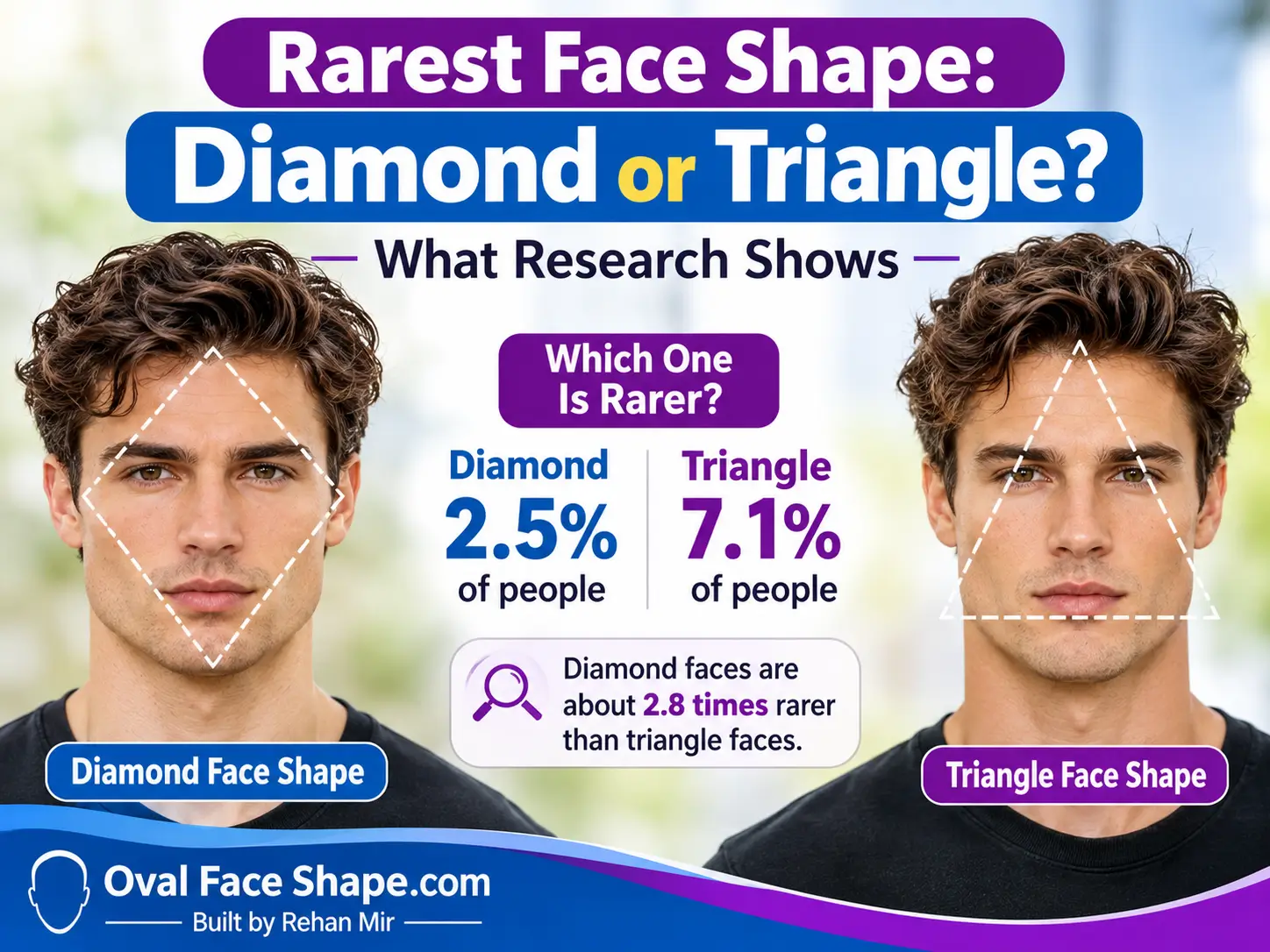
Quick Answer:
Diamond is most often called the rarest face shape, but scan data disagree: only triangle and square fall in the bottom three in both big datasets, and we found no peer-reviewed population count.
By Muhammad Rehan Iqbal, Founder and Developer of OvalFaceShape.com.
Diamond is the rarest face shape according to most style guides, because it needs three conditions at once: cheekbones wider than both forehead and jaw, plus a narrow chin. Published scan data disagree, though, and oval is the only shape every source ranks as most common.
“Discover the rarest eye shapes, eyebrow shapes, and eyelash types with our dedicated guides, each covering their unique characteristics and features.”
Who this guide is for:
Readers whose face shape quiz returned a “rare” result and want to know if it holds up, and anyone who found two rarest face shape lists that contradict each other. This guide explains how to read the data. For hairstyles and glasses, use OvalFaceShape.com’s per-shape guides.
Rarest to most common face shape: Two datasets compared
Two face shape tools publish full breakdowns: OblongFaceShape (51,247 analyses) and FaceAura AI (18,041 scans, September 2026). Ranks run from 1 (rarest) to 7 (most common) within each dataset.
| Face shape | OblongFaceShape | Rank | FaceAura AI | Rank | Reading |
|---|---|---|---|---|---|
| Triangle | 8.6% | 2 | 0.05% | 1 | Bottom three in both |
| Square | 9.5% | 3 | 1.23% | 3 | Bottom three in both |
| Diamond | about 5% | 1 | 24.99% | 5 | Datasets contradict |
| Oblong / rectangle | 21.7% | 6 | 1.09% | 2 | Datasets contradict |
| Heart | 14.1% | 4 | 25.69% | 6 | Mid-range to common |
| Round | 17.3% | 5 | 8.16% | 4 | Mid-range |
| Oval | 28.4% | 7 | 38.78% | 7 | Most common in both |
Only three shapes behave consistently. Oval is most common in both, while triangle and square land in the bottom three in both. Diamond and oblong swing from near the bottom in one dataset to near the top in the other.
Both datasets count people who chose to use a tool, not a random population sample. OblongFaceShape’s percentages add up to about 105%, so treat its figures as approximate.
For a side-by-side view of all seven, see the Face shapes Chart.
Why diamond is called the rarest face shape?
Beverly Hills facial plastic surgeon Dr. Patrick Davis told Glam that diamond is the rarest shape, and eyewear and beauty sites repeat the claim. The anatomical logic is the stronger argument. The diamond face shape needs a narrow forehead, prominent cheekbones and a tapering chin together. Each trait is common alone, but the combination is not.
This is a rule-counting effect: The more conditions a definition demands, the fewer faces meet it. Oval has the loosest rules, so it is the most common. Rihanna and Robert Pattinson are frequently cited diamond examples.
We found no population count behind the diamond claim, and FaceAura AI’s log puts diamond third most common. Treat diamond’s status as a strong convention, not a measured fact.
Why scan data disagree on rarity?
- Self-selected users. Each site attracts a different audience.
- Different cut-offs. A rule requiring cheekbones 10% wider than the forehead labels more faces diamond than a 15% rule. Building the Face Shape Detector on OvalFaceShape.com means choosing thresholds like these, and every choice moves borderline faces between shapes.
- Different shape lists. Tools use six, seven or eight shapes, and FaceAura AI groups oblong with rectangle.
- No expert agreement. Tio (2019) found that 62 of 117 female celebrities with two or more published labels had conflicting face shapes across 21 websites.
Percentages are directional. The ranking logic holds up better than any single figure.
Rarest face shape for Men and Women: Measured Studies
Researchers skip labels like “diamond” and measure the facial index: Face length divided by bizygomatic (cheekbone) width. Ozsahin et al. (2016) measured 1,003 Turkish adults using Banister’s classification.
| Banister type | Men (470) | Women (533) |
|---|---|---|
| I: very broad | 18.1% | 15.6% |
| II: broad | 35.3% | 34.3% |
| III: medium | 33.2% | 34.3% |
| IV: long | 8.7% | 11.8% |
| V: very long and narrow | 4.7% | 3.9% |
Very long, narrow faces were rarest in both sexes. These categories measure length-to-width, not jaw or cheek geometry, so they cannot say whether diamond or triangle is rarer. We found no verified sex split for the seven style shapes, and one national sample is not a worldwide answer.
2nd, 3rd and top-5 Rarest Face Shapes
Triangle is the most consistent low-ranker: rarest in FaceAura AI’s data and second rarest in OblongFaceShape’s. The triangle face shape has a jaw wider than the cheekbones and forehead, the reverse of heart.
Square is third in both datasets. It needs forehead, cheekbones and jaw of nearly equal width, plus angular corners. A strong jaw alone is not enough.
Third place in a top-three list is disputed: Diamond in one dataset, oblong or rectangle in the other. The fourth slot also splits, with heart in one and round in the other.
Rarest face shape in India and the world
We found no published population study of the seven style shapes for India, and tools don’t publish country splits. A worldwide ranking is a dataset average, not a census. If you’re reading from India, your own measured proportions are more reliable than any national claim.
Most Common Face shape: Oval
Oval ranks first in both datasets (28.4% and 38.78%). It needs the fewest simultaneous conditions. On OvalFaceShape.com, an oval face measures roughly 1.3 to 1.5 times as long as it is wide at the cheekbones, with softly curved forehead and jaw.
Rarest face shape test: Check yours in Four Steps
- Take a straight-on photo with your hair off your forehead.
- Measure forehead, cheekbone and jaw widths and face length from hairline to chin. These follow standard landmarks from Farkas (1994).
- Find the widest point. Cheekbones widest with narrower forehead and jaw points to diamond. A widest jaw points to triangle. Three near-equal widths with angular corners point to square.
- Divide face length by cheekbone width. Above about 1.5 leans oblong.
If two methods disagree, you likely sit between shapes, which is common. The Face Shape Calculator does the maths from four tape measurements.
Key Takeaways
- Diamond is the most-cited rarest face shape, but no measured population count supports it.
- Triangle and square are the only shapes in the bottom three of both major scan datasets.
- Oval is the most common face shape in both datasets.
- Measured studies rank very long, narrow faces as rarest (4.7% of men, 3.9% of women in one Turkish sample), using a different system.
- A rarity percentage depends on the tool’s cut-offs, so confirm your shape by measurement.
FAQs
What face shape is most attractive?
No shape wins. Research links attractiveness to symmetry, averageness and proportion (Rhodes, 2006), not to rarity.
“Discover which face shapes are commonly considered attractive and explore the features behind these perceptions in our detailed guide to the most attractive face shape.”
What is the least popular face shape?
No shape is unpopular. If you mean least common, triangle and square rank lowest across both datasets.
What is the luckiest face shape?
Luck by face shape comes from face-reading tradition and has no scientific support.
Is diamond really the rarest face shape?
Unproven. It’s the most-cited, but one dataset has it near 5% and another near 25%.
How do I tell diamond from heart?
Check the forehead. Diamond has cheekbones widest and a narrow forehead; heart has the forehead widest.
How can I find out how rare my face shape is?
Not precisely, because no reliable population data exists. Measure your shape, then compare it with the table.
Why does one test say diamond and another heart?
Tools use different cut-offs for borderline faces, so one face can land in two shapes.
Not sure which shape you are? Run the Face Shape Detector, then read the guide for your result.