
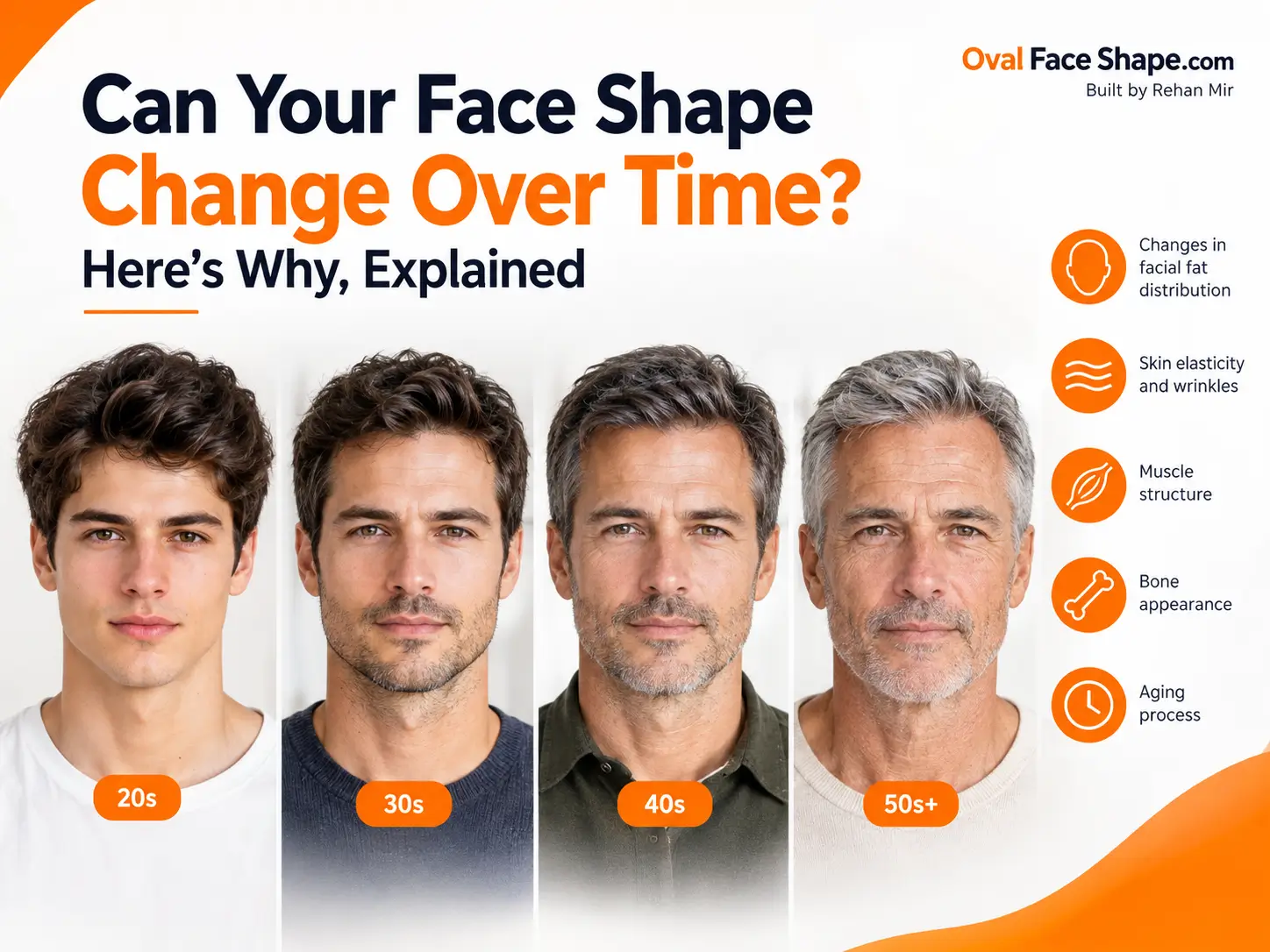
Quick Answer:
Yes — but only partly. Your bone structure locks in by your late teens to early twenties and stays essentially fixed. What actually shifts afterward is the soft tissue layered over it.
Who this guide is for:
If you were told your face shape years ago — for a haircut, glasses, or a face-shape quiz — and it doesn’t look quite right anymore, you’re not imagining it.
This is written for anyone re-checking an old face-shape result after weight change, aging, or simply a new photo, using OvalFaceShape.com’s Face Shape Detector to confirm what’s changed and what hasn’t.
Key Takeaways
- Your skeletal face shape (jaw and cheekbone width, the ratio your shape is actually measured on) is essentially set by your late teens to early twenties.
- What visibly changes afterward is soft tissue — fat volume, skin elasticity, and gravity — not the underlying bone.
- Weight loss or gain is the single biggest driver of a face looking like it’s “changed shape” in adulthood.
- Bone remodeling does continue in small, slow ways across decades, but it’s not what most people mean when they ask this question.
- The only way to know for certain is to re-measure — a quiz based on memory or an old photo won’t catch it.
Bone vs. Soft Tissue: What “Face Shape” Actually Means
Face shape, as OvalFaceShape.com’s detector measures it, is defined by skeletal landmarks — bizygomatic width (cheekbones), bigonial width (jaw), and forehead width, compared as ratios. That skeletal framework is what people mean by “oval,” “square,” or “round.” Once facial bone growth completes, those ratios don’t swing dramatically on their own.
What does move is everything layered on top of the bone: subcutaneous fat, skin, and muscle. A widely cited beauty-editorial explanation puts it simply — natural weight fluctuation changes how the face looks, but this isn’t based on the bone structure itself, which is what determines your face shape.
That distinction — visible change vs. structural change — is the whole answer to “can your face shape change naturally.” escentual
Want to understand how facial landmarks work, how facial symmetry is measured, and what face shape statistics reveal? Explore our detailed guide.
At What Age Does Face Shape Change?
Skeletal facial growth is largely complete by the late teens to early twenties, after which the jaw and cheekbone dimensions that define your shape stop shifting on their own.
From that point, two separate processes run in parallel for the rest of life:
- Soft tissue changes (visible, ongoing): Fat volume and skin elasticity shift continuously with weight, age, and lifestyle — this is what makes a face look rounder, gaunter, or “softer” over the years.
- Slow bone remodeling (subtle, cumulative): Craniofacial research using CT and 3D imaging has documented that the facial skeleton keeps remodeling in small ways across adulthood — for example, the orbital aperture increases with age, in both area and width, and remodeling of the facial skeleton occurs unabated regardless of the state of the dentition, although the loss of dentition significantly accelerates bony resorption of the maxilla and mandible.
- A separate 3D-imaging study tracking hundreds of adults aged 22–88 similarly found measurable shape and size changes in facial morphology across each decade of life. None of this is dramatic enough to flip an oval face into a square one — but it means “the bone never changes” isn’t quite the full picture either. springerspringer
What Actually Changes a Face’s Appearance After Your 20s?
- Weight fluctuation — the most common cause. Gaining weight softens a defined jawline toward a rounder look; losing it can reveal underlying bone structure and sharpen the same face.
- Fat pad and skin changes — facial fat sits in distinct compartments that shift and thin unevenly with age, changing contour even at a stable weight.
- Gravity and skin laxity — reduced skin elasticity lets soft tissue settle lower on the face over time.
- Dental loss — losing teeth removes the bone’s normal support and measurably speeds up jaw and maxilla resorption, per the research cited above.
- Orthodontics or jaw surgery — one of the few things that genuinely repositions bone, not just soft tissue, which is why post-treatment faces can look structurally different, not just “aged.”
Does Face Shape Change Differently for Women?
The underlying mechanism — bone stable after skeletal maturity, soft tissue changing continuously — applies to everyone. But research on facial aging patterns has found sex-specific differences in how the soft tissue moves:
Men and women show different rates and patterns of facial bony and soft-tissue change with age, including differences in chin and midface positioning over time.
In practice, this means two people at the same age and similar weight can show visibly different amounts of change — which is exactly why a memory-based guess (“I’m still oval, I think”) is less reliable than re-measuring.
How to Actually Check If Your Face Shape Has Changed?
A quiz you answer from memory, or an old photo, can’t catch a shift that’s already happened. The reliable way is a fresh measurement: OvalFaceShape.com’s
uses live facial-landmark analysis on a current photo to re-calculate your ratios from scratch, rather than assuming your years-old result still holds.Comparison at a Glance
| Bone structure | Soft tissue | |
|---|---|---|
| Sets your core face shape | Yes | No — modifies its appearance |
| Fixed after late teens/early 20s | Mostly | No — changes continuously |
| Main driver of change | Slow decades-long remodeling, dental loss | Weight, age, gravity, skin elasticity |
| Reversible with lifestyle change | No | Partially (weight loss/gain) |
| Changed by orthodontics/surgery | Yes | Indirectly |
FAQs
Can your face shape change naturally?
Yes, but mainly through soft tissue, not bone. Weight change, aging skin, and shifting facial fat can make a face look like a different shape even though the underlying skeletal proportions have barely moved.
At what age does face shape change?
The skeletal shape that defines your category is largely set by the late teens to early twenties. Visible, soft-tissue-driven changes then continue gradually for the rest of adulthood.
Does face shape change differently for women?
The mechanism is the same for everyone, but studies of facial aging have found men and women differ in the rate and pattern of soft-tissue and bony change — so two people the same age can visibly change at different speeds.
Is there a real way to test if my face shape has changed?
Yes — re-measure with a current photo rather than relying on an old result or a memory-based quiz. OvalFaceShape.com’s Face Shape Detector recalculates your ratios from a fresh image.
Can losing weight change your face shape?
It can change how your face looks by reducing fat volume and revealing more of the underlying bone contour, but it doesn’t alter the skeletal measurements a face shape is actually based on.
Does face shape change after braces or jaw surgery?
Yes — this is one of the few cases where bone itself is repositioned, not just soft tissue, so a genuinely different structural shape afterward is expected, not just a styling change.
What is the most attractive face shape?
There isn’t a single answer research supports — attractiveness studies point more consistently to facial symmetry and proportion than to any one category being universally “best.” Oval is often cited as versatile for styling purposes, not as objectively more attractive.