
Quick Answer:
Eye spacing ratio measures the horizontal distance between the eyes relative to face width or eye dimensions. A commonly referenced ratio is about 0.46, but normal facial proportions vary widely, so it should be viewed as a general reference—not a fixed ideal.
By Muhammad Rehan Iqbal, Founder and Developer of OvalFaceShape.com, specializing in face shape analysis and interactive facial assessment tools.
Eye spacing ratio is the distance between your eyes divided by a reference width, usually your cheekbone (bizygomatic) width. In a widely cited study, attractiveness peaked when the eye distance was about 46% of face width, or roughly 0.46. A second rule of thumb says the gap between the inner eye corners should equal one eye width. mcmaster
Who this guide is for:
This guide is for anyone who wants to measure their own eye spacing from a front-facing photo and compare it with published benchmarks. It is face-proportion education, not a medical assessment. It also helps readers who are confirming a face shape or choosing glasses.
What Eye Spacing Ratio Measures?
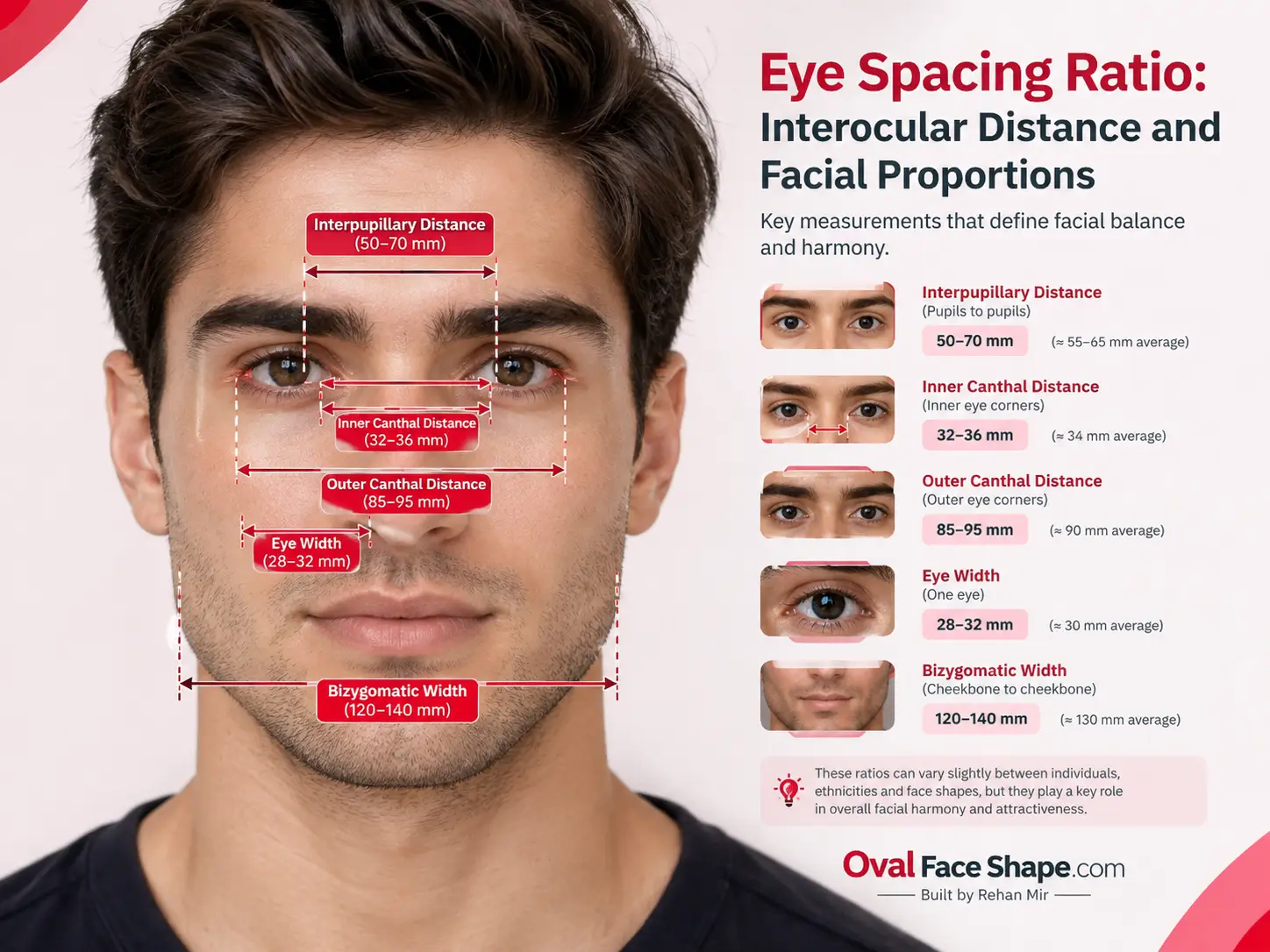
“Eye spacing” can mean four different measurements, and mixing them up is why calculators disagree. Researchers recommend interpupillary distance (IPD) for objectively judging eye spacing. “Interocular distance” is the everyday term for the same pupil-to-pupil gap. nih
| Measurement | Between which points | Used for |
|---|---|---|
| Interpupillary distance (IPD) | Centers of the two pupils | Eye spacing ratio, glasses |
| Inner canthal distance (ICD) | Inner corners of the eyes | Five-eye check |
| Outer canthal distance (OCD) | Outer corners of the eyes | Clinical assessment |
| Eye width (palpebral fissure length) | Inner to outer corner of one eye | Five-eye check |
| Bizygomatic width | Widest points of the cheekbones | Ratio denominator |
Eye Spacing Ratio Formula
The common formula is eye spacing ratio = interpupillary distance ÷ bizygomatic width. The five-eye check is separate: inner canthal distance ÷ eye width, ideally near 1.0. perfectcorp
Worked example with illustrative numbers: an IPD of 62 mm and a bizygomatic width of 135 mm give 62 ÷ 135 ≈ 0.46. An eye width of 31 mm with a 32 mm gap between inner corners gives 32 ÷ 31 ≈ 1.03.
Results from different calculators are only comparable when they divide by the same landmark, so check which width a facial proportion calculator uses.
Curious about facial proportions and the Golden Ratio? Explore our guides on Golden Ratio faces, facial thirds and fifths, and the Marquardt Phi Mask to understand how these facial measurement concepts work.
Ideal Eye Spacing Ratio
Pallett, Link and Lee (2010) tested this across four experiments. Faces looked best when the eyes-to-mouth distance was about 36% of face length and the eye gap about 46% of face width, and those values match an average face. In this research, “ideal” means average-proportioned, not rare.
The five-eye convention divides the face width into parts: one eye width, the gap between the eyes, and the space from each outer corner to the face edge, ideally equal. The celebrity golden-ratio faces show how these proportions look on public figures.
Guides often cite a 0.45–0.47 band, but plenty of widely admired faces fall outside it. Treat the number as a reference point, not a score.
Ideal eye spacing for men
Absolute spacing differs by sex. In a Filipino adult sample, mean IPD was 62.59 mm in men and 60.29 mm in women, with inner canthal distance of 34.91 mm versus 31.19 mm. Dividing by face width adjusts the ratio for overall size. No peer-reviewed study I located supports a separate male “ideal” ratio, so online “looksmax” scoring goes beyond the evidence.
How to Measure Eye Spacing at Home?
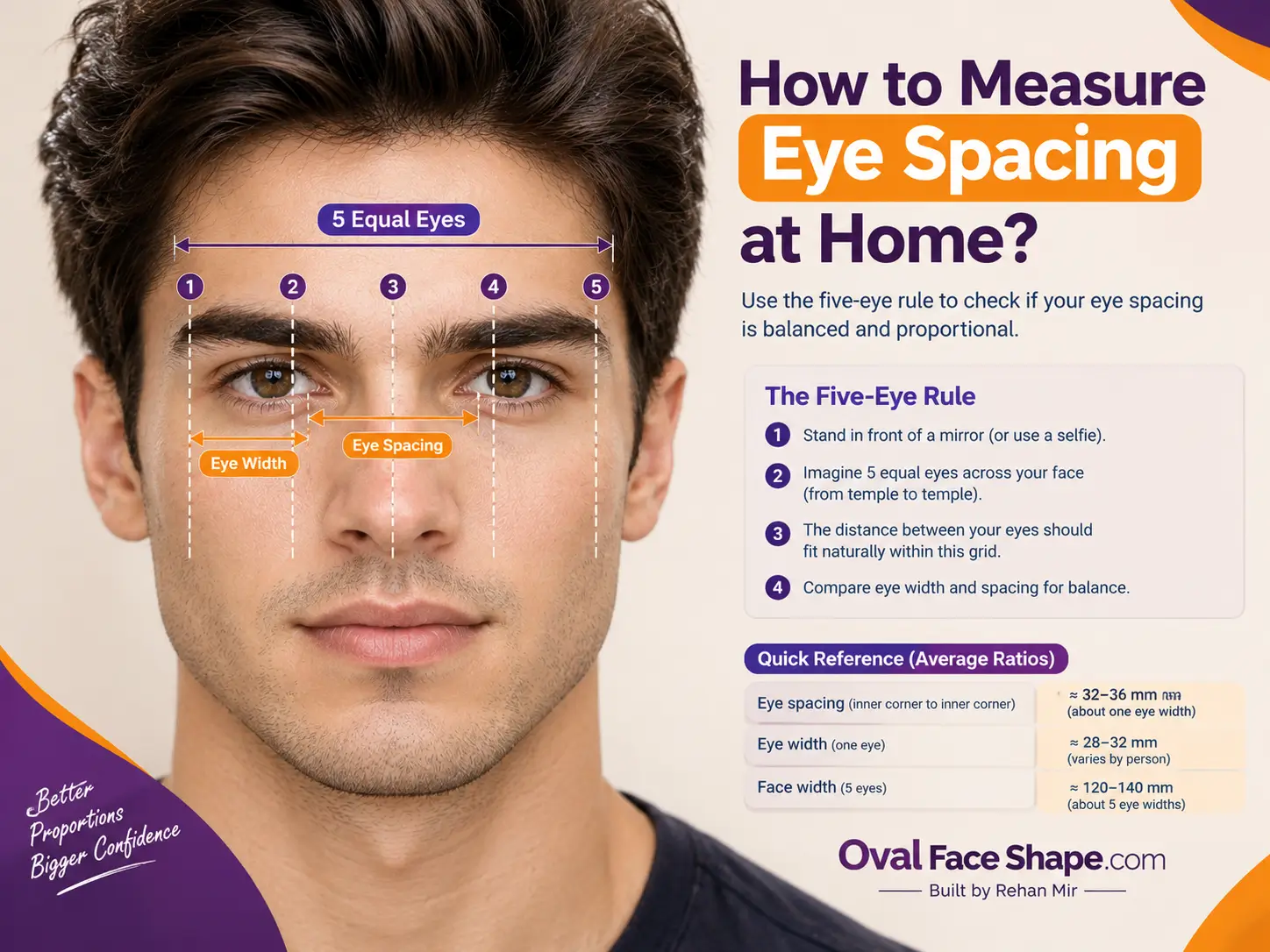
- Take a front-facing photo at eye level, head level, with a neutral expression.
- Measure pupil center to pupil center (IPD) on screen.
- Measure the widest points of your cheekbones in the same units.
- Divide IPD by bizygomatic width.
- For the five-eye check, measure one eye’s width and the gap between inner corners.
Tilted heads and close-up wide-angle shots distort distances, so shoot straight on from a reasonable distance. To compare your overall proportions, the Face Shape Detector places the landmarks for face length and cheekbone width automatically.
Midface Ratio and Face Height-to-Width Ratio
Midface ratio relates eye-to-mouth distance to another measurement, but the direction varies: some guides divide midface length by pupil distance, others do the reverse. The Pallett study divides eye-to-mouth distance by face length (hairline to chin).
Face height-to-width is a different job. OvalFaceShape.com divides face length by cheekbone width, and oval faces typically fall between 1.3 and 1.5. No single height-to-width value is “ideal” across shapes. It identifies the shape, as in oval vs oblong.
| Ratio | Formula | Reference value |
|---|---|---|
| Eye spacing ratio | IPD ÷ bizygomatic width | About 0.46 |
| Five-eye check | ICD ÷ eye width | About 1.0 |
| Eye-to-mouth ratio | Eye-to-mouth distance ÷ face length | About 0.36 |
| Face length-to-width | Face length ÷ cheekbone width | Oval about 1.3–1.5 |
Close-Set, Wide-Set or Normal?
There is no single normal gap. In an Iranian adult sample, mean IPD was 62.1 mm with a range of 42–75 mm, 61.1 mm in women and 63.6 mm in men. Averages also shift with ethnicity, sex and age.
The clinical boundary is narrow. True orbital hypertelorism requires inner canthal, outer canthal and interpupillary distances to all exceed the 95th percentile, as AllAboutVision explains. Eyes can also look widely spaced because the inner corners are displaced, a false impression called pseudohypertelorism. A clinician, not a calculator, makes that call.
Eye Spacing, Face Shape and Glasses
Eye spacing is one proportion inside a face. Face shape depends on length, cheekbone width, jaw and forehead, which the types of face shapes guide explains.
Spacing matters in eyewear because IPD must be considered before frame selection so lenses sit correctly in front of the eyes.
For get more details see glasses by face shape for frame choices.
Key Takeaways
- Eye spacing ratio = IPD ÷ bizygomatic width; about 0.46 is the average-face benchmark.
- The five-eye check (inner gap ≈ one eye width) uses different landmarks, so don’t mix the two.
- “Ideal” in the research means average, and admired faces often sit outside 0.45–0.47.
- Normal IPD spans a wide range; hypertelorism needs three measurements above the 95th percentile.
- Compare ratios only between calculators that use the same landmarks.
FAQs
What is the normal gap between eyes?
It depends on what you measure. Pupil to pupil, adults average about 62 mm (range 42–75 mm in one Iranian sample). Between inner corners, Filipino adults averaged about 31–35 mm. pso-hns
What is the 10-10-10 rule for eyes?
It has nothing to do with eye spacing. It’s a screen-break habit: every 10 minutes, look at something about 10 feet away for 10 seconds.
How to calculate eye spacing?
Divide interpupillary distance by bizygomatic width. A result near 0.46 matches the average-face benchmark. For the five-eye check, divide the inner-corner gap by one eye’s width; near 1.0 matches.
What is a normal eye width?
Eye width (palpebral fissure length) averaged 32.6 mm in Filipino men and 31.05 mm in women, and about 27 mm in Serbian young adults. Populations differ, so use it for within-face comparison, not as a target.
Is 0.46 the perfect eye spacing ratio?
No. It marks the study’s average-face optimum, and many admired faces sit outside the commonly cited 0.45–0.47 band.
Eye spacing ratio or five-eye rule: which should I use?
Use the ratio when you have both IPD and cheekbone width. Use the five-eye check for quick comparisons in drawing or makeup. They can disagree because they use different landmarks.
Can you change your eye spacing?
Bony spacing is fixed in adults, but makeup and brow shaping can change how far apart eyes look. Surgery is discussed for diagnosed hypertelorism, which is a specialist decision. vision-boutiqueallaboutvision
Next step:
Place eye spacing within the whole face in Facial Thirds and Fifths.