
Quick Answer:
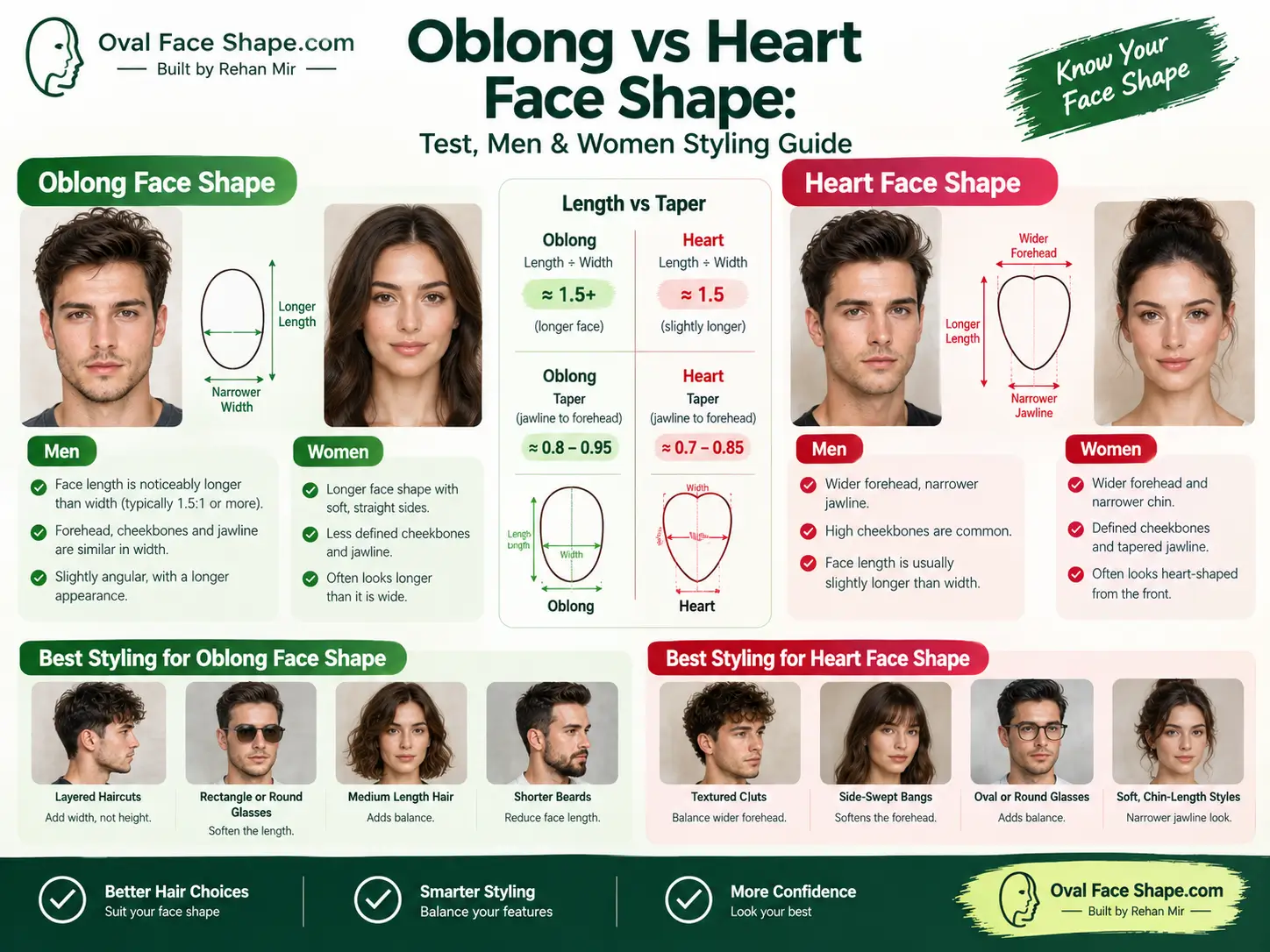
Oblong faces are long, with a jaw nearly as wide as the forehead. Heart faces taper from a wide forehead to a narrow, pointed chin. Measure taper first, then length.
By Muhammad Rehan Iqbal, Founder and Developer of OvalFaceShape.com, who builds face shape analysis tools and styling guides.
An oblong face is defined by length: It is clearly longer than it is wide, and the jaw stays close to the forehead in width. A heart face is defined by taper: a wide forehead narrows to a pointed chin. Length and taper are separate traits, so one face can show both.
Who this guide is for:
This guide is for anyone choosing between the two before picking a haircut, beard or glasses, whether with a tape measure or the Face Shape Detector on OvalFaceShape.com.
What Is an Oblong Face Shape?
An oblong face shape is a long face whose forehead, cheekbones and jaw are similar in width, with fairly straight cheek lines. It is also called rectangle or long. Omni Calculator describes it as close to oval, except that the cheek line is longer and fairly straight.
In styling terms, “oblong” means a face that gains from added width rather than added height. The full profile is in the oblong face shape guide.
What Is a Heart Face Shape?
A heart face is widest across the forehead, then narrows through the cheekbones to a slender or pointed chin. A widow’s peak is common but not required. Because the jaw is the narrowest zone, heart-face styling usually adds visual weight lower down.
For more depth see the heart face shape guide.
Why These Two Shapes Get Confused: Length vs Taper
Most guides treat the shapes as opposites, but they measure different things. Oblong is a length trait and heart is a taper trait. Together they form four outcomes:
| Jaw close to forehead width | Jaw clearly narrower than forehead | |
|---|---|---|
| Long face | Oblong | Long heart (blend) |
| Not especially long | Oval, round or square | Heart |
All About Vision describes swimmer Michael Phelps as having an oblong, heart-shaped face: long, narrow and tapering. That is the “long heart” cell above.
How to Test Oblong vs Heart?
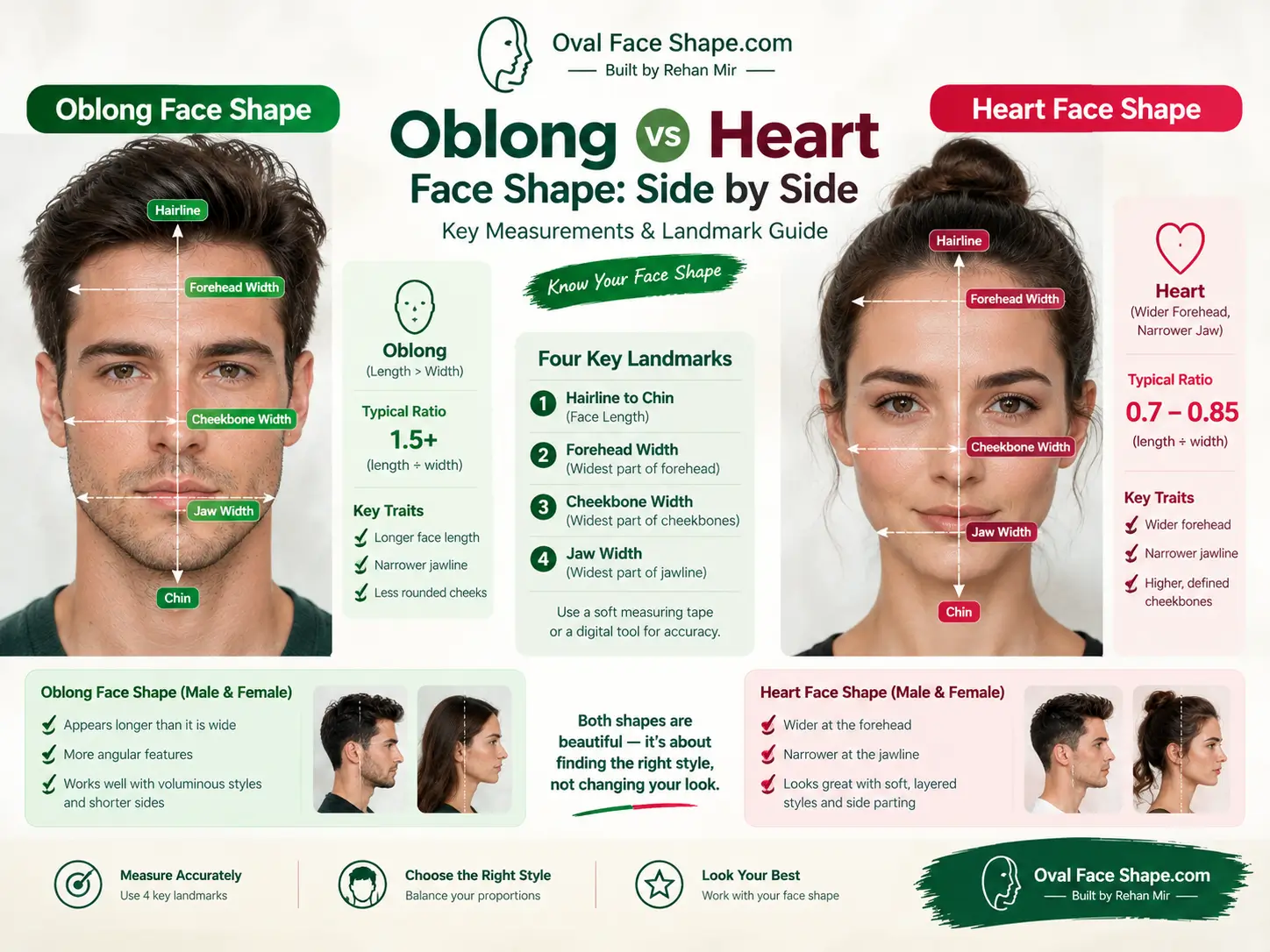
Pull your hair back, relax your face, and use a flexible tape or a ruler against a straight-on photo. The landmarks follow standard facial anthropometry (Farkas, 1994).
- Face length: hairline to chin tip.
- Cheekbone width: widest point across the cheekbones.
- Forehead width: widest point across the forehead.
- Jaw width: across the jaw corners.
Then run two checks:
- Length check: length ÷ cheekbone width. About 1.5 or higher counts as long.
- Taper check: jaw ÷ forehead. 0.90 or higher is even, 0.80 to 0.89 is in between, and below 0.80 is clearly tapered.
Illustrative example (not a real person): 21 cm length, 13.5 cm cheekbones, 13 cm forehead and 11 cm jaw give 1.56 and 0.85. That is a long face with moderate taper, so a long-heart blend.
These cutoffs are this site’s working thresholds, not a published standard. A receding hairline or fringe changes the forehead reading, so measure visible skin and repeat twice.
Compare oval vs. heart face shapes in our complete guide to discover their key differences, defining features, and how to identify each face shape.
Oblong vs Heart Face Shape: Side by Side
| Feature | Oblong | Heart |
|---|---|---|
| Defining trait | Length | Taper |
| Length ratio | About 1.5 or higher | Varies; not the deciding trait |
| Forehead | Similar to the jaw | Widest zone |
| Jaw | Close to forehead width | Clearly narrower |
| Chin | Soft or mildly pointed | Narrow or pointed |
| Styling goal | Add width, limit height | Add weight low, soften the forehead |
Online prevalence figures differ by tool and sample, and no neutral population benchmark exists, so this guide doesn’t rank the shapes by rarity.
If you are weighing oblong against oval instead, read oval vs oblong face shape.
Hairstyles for Women
Oblong: Add width and softness. Layers with side volume, curtain bangs and a full fringe all shorten the visible length. Avoid crown height and very long, flat hair. A Seattle Times feature notes that too-long or very short cuts can accentuate an oblong face.
Heart: Bring hair forward. The same piece recommends styles that bring hair onto the forehead for heart faces. Choose a soft, side-swept or wispy fringe rather than a heavy blunt one, which turns a wide forehead into a solid block. A chin-length bob adds width at the jaw.
Safe overlap: A chin-length bob with a side-swept fringe suits both shapes.
Hairstyles and Beards for Men
Oblong: Skip tall quiffs and pompadours. Textured crops with a fringe and sides with some volume keep the outline wider. A beard fuller at the cheeks and jaw than at the chin adds width, while a long pointed beard adds length.
Heart: A textured fringe or side part breaks up the forehead, and piling height on top makes the face top-heavy. A short-to-medium beard that is fuller along the jaw and chin adds weight to the lower face.
Safe overlap: A textured, side-swept fringe with a beard that is full at the sides and short at the chin. More options are in beard styles by face shape.
Best Glasses to Wear
Oblong faces usually suit deeper or oversized frames and strong horizontal lines, because small frames look lost on a long face. Heart faces usually suit lighter, thin-rimmed, oval or bottom-weighted frames that don’t add weight at the brow. Frame scale often matters more than frame shape.
Can You Be Both? Styling a Blend
Yes. Blends are common, especially long faces with a narrow jaw. Check which trait is stronger. A jaw ÷ forehead ratio below 0.80 means the face is heart-led, and 0.90 or above means oblong-led.
For long faces in the 0.80 to 0.89 range, borrow the shared choices: chin-length or shoulder-grazing waves, a side-swept fringe, a beard full at the sides and moderate frame depth in a light weight.
Scan Your Face Shape
The Face Shape Detector reads facial landmark points from a photo and applies ratio-based rules like those above, so a blend shows up instead of being forced into one label. For a clean scan, face the camera straight on at eye level, keep hair off your forehead and keep a neutral expression.
Scanners estimate. Head tilt, wide-angle lenses and fringes can shift a close result, so treat the output as styling guidance, not a diagnosis.
If your question is about the skull rather than the face outline (for example, a square head shape), see the head shapes guide.
Key Takeaways
- Oblong measures length, and heart measures taper.
- Check taper first (jaw ÷ forehead), then length (length ÷ cheekbone width, about 1.5 or higher).
- A long face with a narrow jaw is a blend, and you follow the stronger trait.
- Styling advice here is visual-balance convention, not research, and no shape is objectively better.
- Safe overlaps: a chin-length bob or side-swept fringe, and a beard full at the sides and short at the chin.
Next step:
With your result in hand, open Hairstyles for Every Face Shape to compare cuts for oblong and heart faces.
FAQs
Is oblong an attractive face shape?
No face-shape category is objectively more attractive, and no reliable research ranks these styling shapes. Oblong faces are often described as elegant with strong structure, but haircut, grooming and expression shape the impression more than the outline.
What is the luckiest face shape?
No shape is scientifically lucky. “Lucky” face shapes come from traditional face reading (physiognomy), a cultural practice with no evidence that facial shape predicts luck, and its categories differ from the styling shapes used here.
Is heart shape face attractive?
No category is objectively more attractive. Heart faces are often described as having a delicate chin and defined cheekbones, and the styling goal is balance, not “fixing” the shape.
Does a long face always mean oblong?
No. Oblong needs length and a jaw close to forehead width. A long face with a jaw clearly narrower than the forehead is a long-heart blend.
My face is long, but my forehead is big and my jaw thin. Oblong or heart?
Run the taper check first. A jaw ÷ forehead ratio below about 0.80 leans heart, so style the forehead and jaw before worrying about length. This mix-up comes up often in grooming-forum threads.
Is face shape still worth using for hair and glasses?
Yes, as a shortlist rather than a rulebook. Hair texture, hairline and frame fit matter as much, so narrow options by face shape, then try them.
Can a face shape scanner tell oblong from heart?
Often, if the photo is straight-on and the hair is off the forehead. Scanners estimate from landmark ratios, so tilted heads, wide-angle selfies or fringes can flip a close result. Confirm with a tape measure.