
Quick Answer:
Golden-ratio faces don’t need a special haircut. Pick cuts that make the face read about 1.5× longer than wide, frame the cheekbones, and use the 2.25-inch rule for short vs. long.
By Muhammad Rehan Iqbal, Founder and Developer of OvalFaceShape.com, specializing in face shape analysis, interactive facial assessment tools, and educational styling guides.
A golden ratio face is one whose length is close to 1.618 times its width. Hairstyles for a golden ratio face are haircuts chosen to keep that balance visible, matched to the face shape those proportions produce.
Who this guide is for:
This guide is for anyone at OvalFaceShape.com who has a golden ratio result and needs a practical cut. It covers men, women and every length. It does not re-teach measuring, which our golden ratio face proportions guide handles.
Discover your facial proportions and see how they compare with the golden ratio using our Golden Ratio Face Detector.
Do Golden Ratio Faces Need a Special Haircut?
No. The golden ratio describes proportion, and hair changes how those proportions read.
In a Vision Research study, Pallett and colleagues found the most attractive eye spacing sat at about 46% of face width, matching an average face rather than 1.618. Lead author Pallett told NBC News that pulling hair back or letting it fall in front of the ears can shift these ratios.
Co-author Kang Lee said haircuts alter the ratios, and that Shania Twain met both of the study’s ratios while Angelina Jolie did not.
Two limits apply: The study used only white female faces. A 2026 preprint, which has not been peer reviewed, found a similar preference for averageness in male faces, with an optimum between 45.7% and 46.4%.
See how real celebrities compare in our golden ratio celebrities list.
Step 1: Read Your Length-to-Width Ratio
Divide face length (hairline to chin) by cheekbone width. OvalFaceShape.com treats 1.3–1.5 as the oval range, which sits just under the 1.618 ideal. These bands are styling guidance, not research results.
| Ratio | What it means | What hair should do |
|---|---|---|
| Under about 1.3 | Wider, rounder | Add height; avoid wide side volume |
| About 1.3–1.5 | Near-balanced | Most cuts work; choose by texture |
| Over about 1.5 | Longer | Add width at the sides; limit height |
Haircuts for a Golden Ratio Face: Men
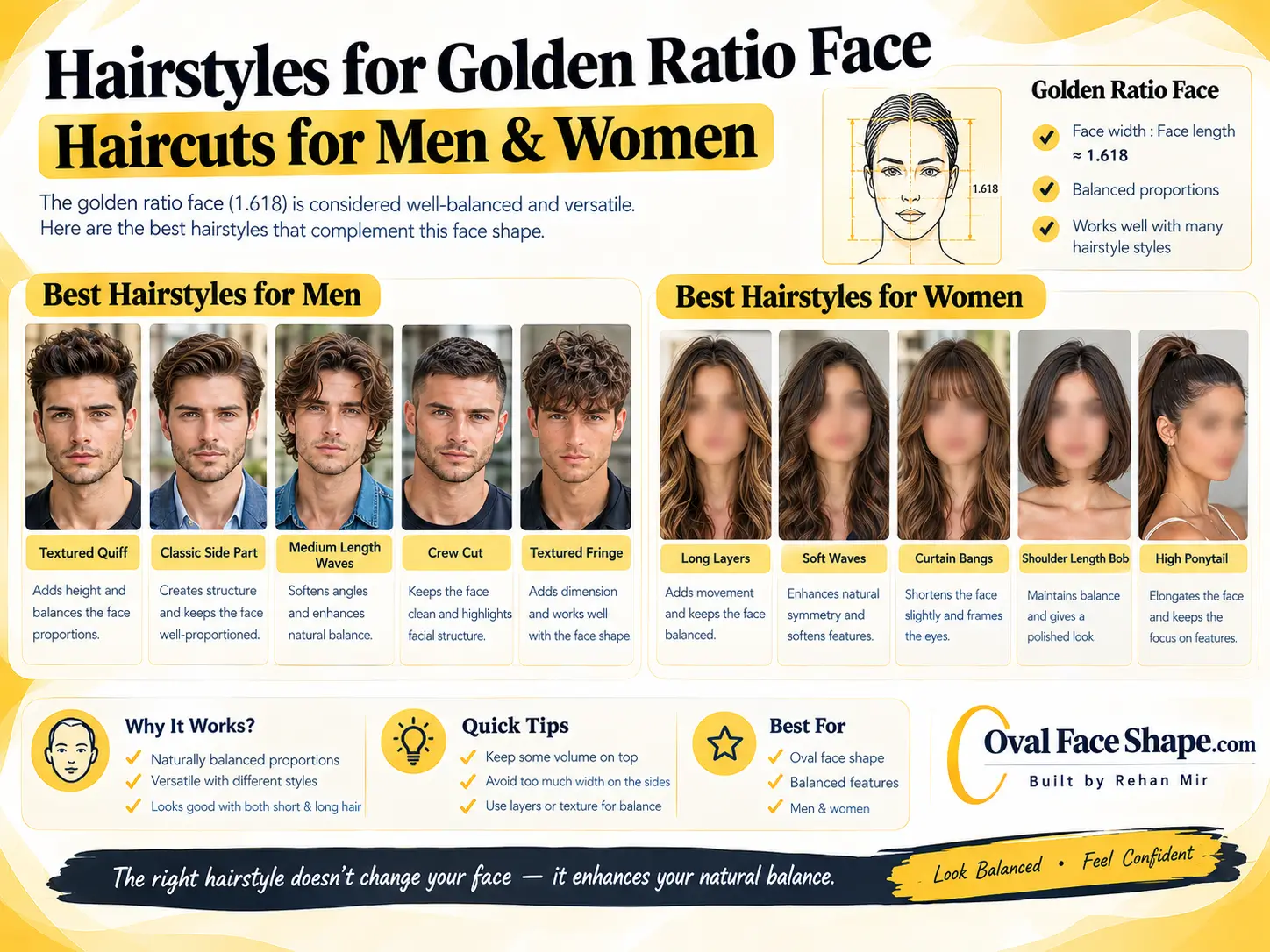
For a near-balanced face, a textured crop, a side-swept cut or a mid taper fade keeps the proportions intact. For a longer ratio, add a fringe and keep the sides fuller. For a wider ratio, add lift on top with tighter sides.
Compare close neighbors in oval vs oblong face shape.
Hairstyles for a Golden Ratio Face: Women
A near-balanced face suits soft layers, a lob or a side part, because little correction is needed. A longer face benefits from chin-length bobs, curtain bangs and side volume. A wider face benefits from long layers and crown height. Perfect Corp’s tool page notes that side parts and face-framing layers soften outlines.
Medium and Long Haircuts
| Length | Effect on visible ratio | Best for |
|---|---|---|
| Short | Exposes full face length and jaw | Near-balanced, narrow jaw |
| Medium (chin to collarbone) | Frames the face and adds width at the jaw | Longer faces |
| Long | Adds length, draws the eye down | Wider faces |
A fringe shortens the visible length, and a high top lengthens it. Browse every shape in our hairstyles for every face shape guide.
Golden Ratio Hair Length and the 2.25-Inch Rule
No study validates a “golden ratio” hair length. The best-known guide is stylist Giles Robinson’s 2.25-inch rule. Measure from the earlobe to the chin with a ruler and pencil. Under 2.25 inches suggests short hair suits you. Treat it as one feature, not a verdict.
Key Takeaways
- No haircut is “the” golden ratio haircut. Cut, length and face shape matter more than the score.
- Measure length ÷ cheekbone width, then add width, add height, or keep it as is.
- Hair changes visible ratios, so fringes and parts can shift your result.
- The 2.25-inch rule helps with short vs long, but it is only a guideline.
Next step: Run the Face Shape Detector to confirm your shape before booking a cut.
FAQs
What is the 3 hair rule?
The phrase has no single standard meaning. Aggregator sites usually describe a looser “3-inch” version of the 2.25 rule, with no named originator I could find. Barbers also use “3-2-1” for guard sizes, and colorists use a “rule of three” for lightness steps. For face shape, use the 2.25-inch rule.
What is the 2.25 hair rule?
Giles Robinson of Color Wow and John Frieda Salons UK developed it. Measure from the earlobe to the chin. Under 2.25 inches (5.5 cm) suggests short hair, and more suggests longer styles. Stylist Kerrie Urban told Allure there are always exceptions.
Does a high golden ratio score mean any haircut will work?
No. A score measures proportion, not how a cut handles your hair texture, density or hairline. Use the ratio table above, then adjust for hair type.
Is the golden ratio still useful in 2026?
It is a rough starting point, not a rule. A 2024 review is titled “The golden ratio—dispelling the myth,” and the newer research points to averageness rather than 1.618.
Is a golden ratio face the same as an oval face?
Not exactly. The golden ratio targets about 1.618, while OvalFaceShape.com’s oval range is 1.3–1.5. A face near 1.5 usually lands in oval territory.
How do I measure my ratio for a haircut?
Pull your hair back and take a straight-on photo. Measure cheekbone width, then hairline to chin, and divide length by width.
Can a haircut change my golden ratio result?
Yes. Hair covering the forehead or ears changes the visible length and width in a photo, which is why Pallett suggested simple hair changes. Re-test with hair pulled back.