
Quick Answer:
Curtain bangs suit most face shapes; face shape only changes the length. Round: long and wispy. Square: soft and long. Oblong: full. Heart: short in the middle. Oval: any.
By Muhammad Rehan Iqbal, Founder and Developer of OvalFaceShape.com.
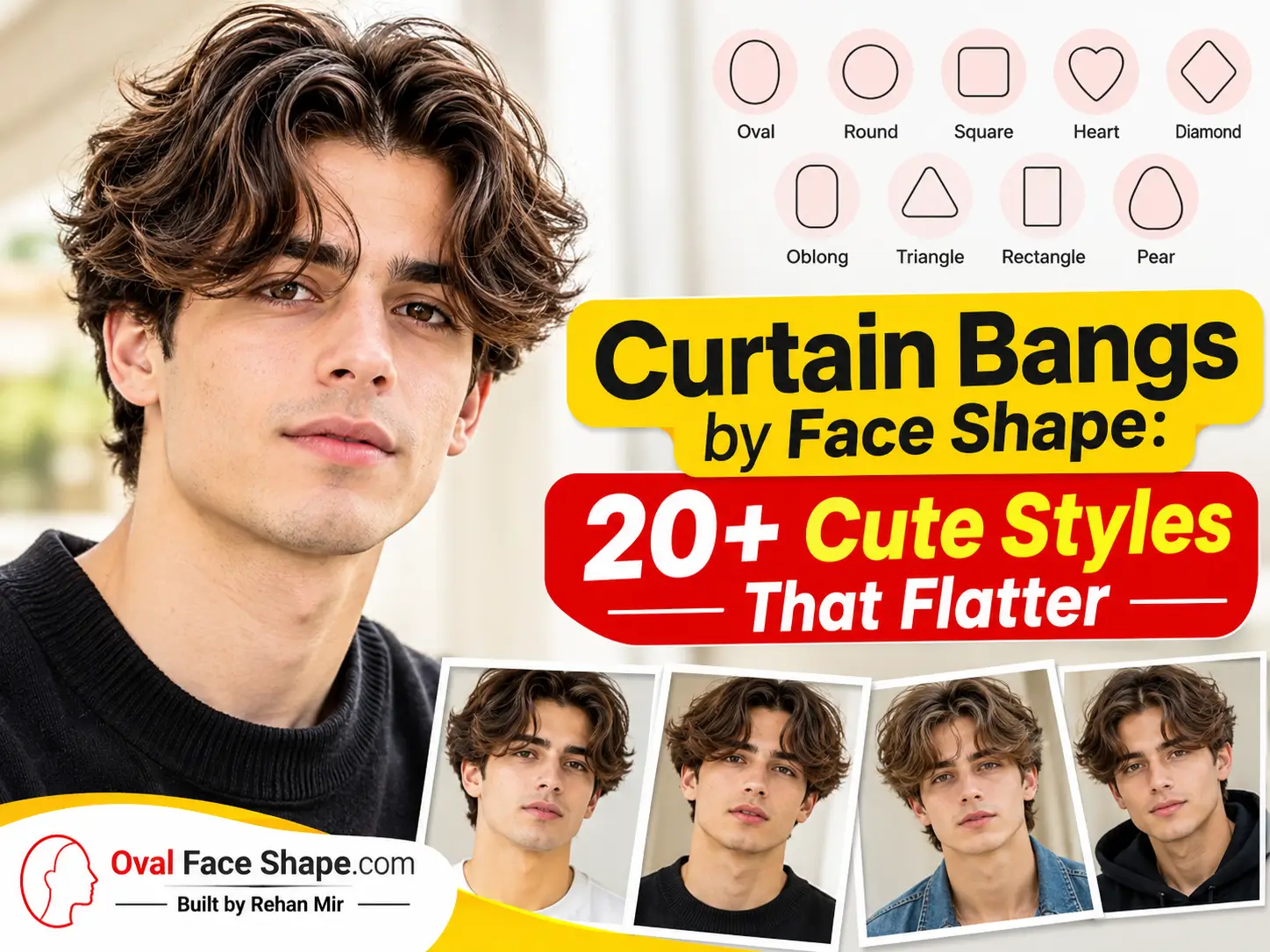
Curtain bangs are a middle-parted fringe, shortest at the center and longer toward the sides, that frames the face like curtains. Choosing curtain bangs by face shape means tuning that length and fullness to your forehead, cheekbones, and jaw: oval, round, square, rectangle (oblong), heart, diamond, triangle, or inverted triangle.
Who this guide is for:
This guide is for anyone picking curtain bangs before a salon visit, with separate sections for men and for short, straight, and wavy hair. It covers the shape-to-style decision, not face measuring; the Face Shape Detector handles that.
How to Choose Curtain Bangs for Your Face Shape?
Match the bang’s shortest point and fullness to what you want to balance. Check three things:
- Face shape. Lengthen round faces, widen long faces, soften angular ones.
- Forehead height. Taller foreheads handle fuller, brow-level bangs; low hairlines need lighter ones.
- Hair density. Thin hair suits a lighter bang; thick hair carries more weight.
Face proportions are measurable (see Farkas, Anthropometry of the Head and Face), but how a bang changes the way a face reads is stylist convention, not tested science. Treat the styles below as starting points to show a stylist.
Types of Curtain Bangs at a Glance
| Type | Shortest point | Suits |
|---|---|---|
| Brow-skimming | Eyebrows | Oval, square, triangle |
| Classic | Eyebrows to cheekbones | Oval, heart, diamond |
| Cheekbone-length | At or below cheekbones | Round, rectangle, diamond |
| Long | Jawline | Round, square, inverted triangle |
24 Curtain Bang Styles by Face Shape
Oval Face
Oval faces carry nearly any length, so choose by taste:
- Classic full curtains: brow-grazing center, cheekbone-length sides.
- Long curtains: sides reach the jaw for a softer frame.
- Feathered 70s curtains: dense but airy ends, never blunt.
Unsure whether you are oval or oblong? Compare them in Oval vs Oblong Face Shape.
Round Face
The goal is length. Keep the center short and the sides long so lines run downward, as in the soft fringe Selena Gomez has worn, a round-face example in the Round Face Shape guide.
- Wispy cheekbone-grazing curtains: thin and textured.
- Long side-swept curtains: a diagonal sweep past the cheek.
- Tapered curtains with long layers: layers extend the downward line.
Avoid blunt, straight-across bangs, which add horizontal width.
Square Face
Soften the forehead corners and the jaw angle.
- Long retro curtains: sweep past the cheeks to blur the jaw.
- Short textured curtains: broken, piecey ends instead of a clean edge.
- Wispy side-swept curtains: light density keeps the forehead from looking boxy.
The Square Face Shape guide covers the proportions in full.
Rectangle and Oblong Face
Long faces gain from width and horizontal lines:
- Full, voluminous curtains: density across the forehead shortens the face.
- Cheekbone-length curtains: shortest pieces at or just below the cheekbones.
- Layered curtains with side layers: layers add width at the sides.
Skip choppy, rigid cuts, which stress length.
Heart Face
A wide forehead tapers to a narrow chin, so soften the top and add weight lower:
- Short-center, long-side curtains: the center opens the forehead while the sides frame it.
- Jaw-length curtains: carry visual weight toward the chin.
- Feathered curtains with chin-length layers: a gradual line from forehead to jaw.
“Explore our detailed guides to discover how wolf cuts and butterfly haircuts suit different face shapes, with styling insights and recommendations for each face shape.”
Diamond Face
Narrow forehead and chin, wide cheekbones:
- Cheekbone-start curtains: the fringe begins just below the widest point.
- Jawline-ending curtains: sides stop at the jaw to add definition.
- Fuller brow-level curtains: add width to the narrow forehead.
Triangle (Pear) Face
A narrow forehead above a wider jaw needs width at the top. The Pear Face Shape guide explains the balance.
- Voluminous brow-level curtains: build width across the forehead.
- Textured side-swept curtains with crown lift: lift draws the eye upward.
- Fluffy blow-dried curtains: a round brush adds airy volume.
Inverted Triangle Face
A wide forehead and narrow chin call for less width on top and more below:
- Light wispy curtains: thin density keeps the forehead narrow.
- Long curtains with flicked ends: ends turn outward at the jaw for width.
- Curtains blended into a collarbone lob: the lob adds weight lower down.
Curtain Bangs for Men
Men’s curtain bangs are a longer middle-parted fringe over short or faded sides, often called curtains. Man of Many lists three barber builds: Short curtains with scissor-cut sides, a middle part with faded sides, and a middle-part undercut, all best on straight, wavy, or thick hair.
Round and square faces usually keep the sides tight to avoid extra width; long faces can leave them fuller.
Curtain Bangs for Straight, Wavy, and Short Hair
- Straight hair: hangs flat, so blow-dry with a round brush for the curve and ask for a wispier cut so the center does not split.
- Wavy hair: holds the curtain shape naturally; ask for a dry cut so the stylist sees where waves spring up.
- Short hair: brow-skimming curtains pair best with pixies and bobs, while long curtains need hair that can sweep behind the ears.
- Cowlicks: a strong cowlick at the front hairline fights the center part, so ask your stylist to check it first.
“Explore our guides to discover the best pixie cuts and broccoli haircuts for different face shapes, along with styling recommendations for each.”
Styling and Cutting Curtain Bangs
Blow-dry damp bangs with a round brush, away from the center part, then cool the hair to set the shape. Let a stylist make the first cut, because length decides the effect on your face.
Hair grows about half an inch a month, according to the American Academy of Dermatology, so growing out one inch takes roughly two months. Trim every four to six weeks, the interval stylists commonly advise.
About the Author
Muhammad Rehan Iqbal is the Founder and Developer of OvalFaceShape.com, specializing in face shape analysis, interactive facial assessment tools, and educational styling guides.
Key Takeaways
- Curtain bangs suit most face shapes; length and density change by shape.
- Round and square: long and soft. Oblong: full. Heart and diamond: start near the cheekbones. Triangle: volume on top. Inverted triangle: light, with flicked ends.
- Shape-to-bang matching is stylist convention, not tested science.
- Hair texture, hairline, and cowlicks matter as much as face shape.
- Heavy, blunt bangs cause most problems, not curtain bangs themselves.
FAQs
What face shape do curtain bangs suit the most?
Oval, because it carries nearly any length. Round, square, and heart shapes also do well with the right length.
Do bangs make you look older or younger?
Soft curtain bangs tend to read younger, while heavy blunt ones can read older. No study measures this, so length and texture matter more.
What face shapes don’t suit curtain bangs?
None are ruled out. Trouble comes from heavy blunt cuts, very low hairlines, or a strong cowlick.
Who can pull off curtain bangs?
Almost anyone, once length and density match the face and hair texture. Have a stylist check cowlicks first.
How are curtain bangs different from wispy or side-swept bangs?
Curtain bangs part in the center and sweep both ways. Wispy describes thin density; side-swept bangs fall to one side.
How often should curtain bangs be trimmed?
Every four to six weeks is typical stylist advice. As they grow, they blend into face-framing layers.
Are curtain bangs still in style?
Stylists treat them as a long-running staple rather than a passing trend, and they grow out gently.
Next step: Know your shape? Match it to a full haircut in Hairstyles for Every Face Shape.