
Quick Answer:
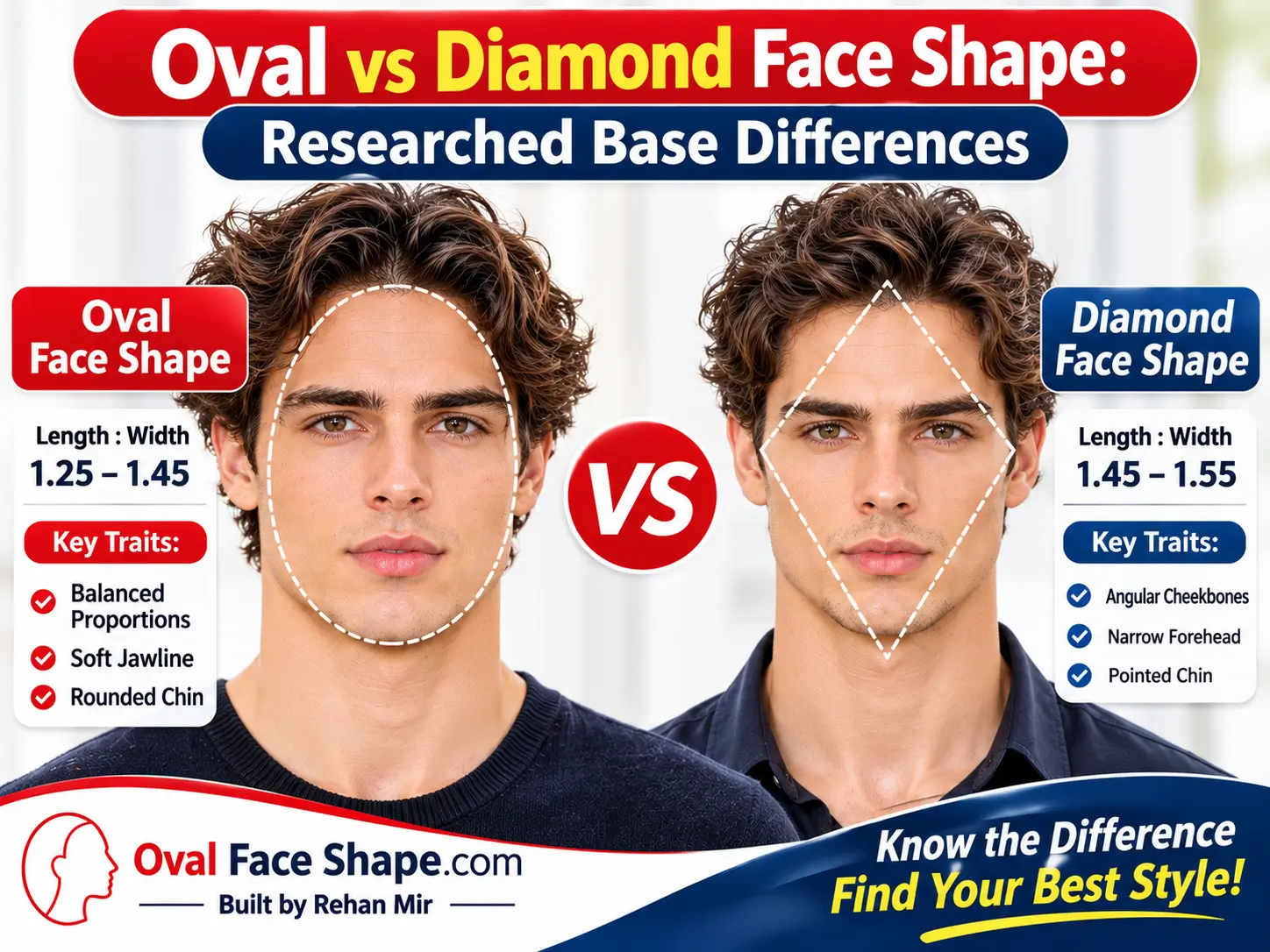
Oval faces curve gently, with the forehead, cheekbones, and jaw close in width. Diamond faces have cheekbones clearly wider than a narrower forehead and a pointed chin.
By Muhammad Rehan Iqbal, Founder and Developer of OvalFaceShape.com, specializing in face shape analysis and interactive facial assessment tools.
An oval face shape is a balanced, longer-than-wide outline where the forehead, cheekbones, and jaw stay close in width, and the chin is rounded. A diamond face shape has a similar length but one clear width peak at the cheekbones, with a narrower forehead and chin. OvalFaceShape.com treats both as styling labels, not medical categories.
Who this guide is for:
This guide is for men and women who land between the two and need one label before choosing a haircut, glasses or beard. It covers a three-width test, a photo setup that doesn’t skew the result, and styling for each shape.
For the full seven-shape method, see the oval face shape guide.
Oval vs Diamond Face Shape: Side-by-Side Comparison
| Feature | Oval | Diamond |
|---|---|---|
| Widest point | Cheekbones, only slightly (or nearly equal to forehead) | Cheekbones, clearly |
| Forehead / temples | Close to cheekbone width | Narrow, tapering inward from the cheekbones |
| Jawline | Tapers gradually | Narrows sharply toward the chin |
| Chin | Rounded | Pointed or narrow |
| Outline | One smooth curve | Two angle shifts: at the temples and at the jaw |
| Length ÷ cheekbone width | About 1.3–1.5 | Often similar, so length alone can’t separate the two |
The deciding factor is the gap between cheekbone width and the other two widths, not face length.
The Three-Width Test: Which Shape Do You Have?
Open one straight-on photo and compare four spans on screen:
- Face length: hairline midpoint to the tip of the chin.
- Temple width: the widest upper-face span at the temples, not the hairstyle.
- Cheekbone width: the widest horizontal span across the cheeks (bizygomatic width in anthropometry).
- Jaw width: between the outer jaw angles, not beside the mouth.
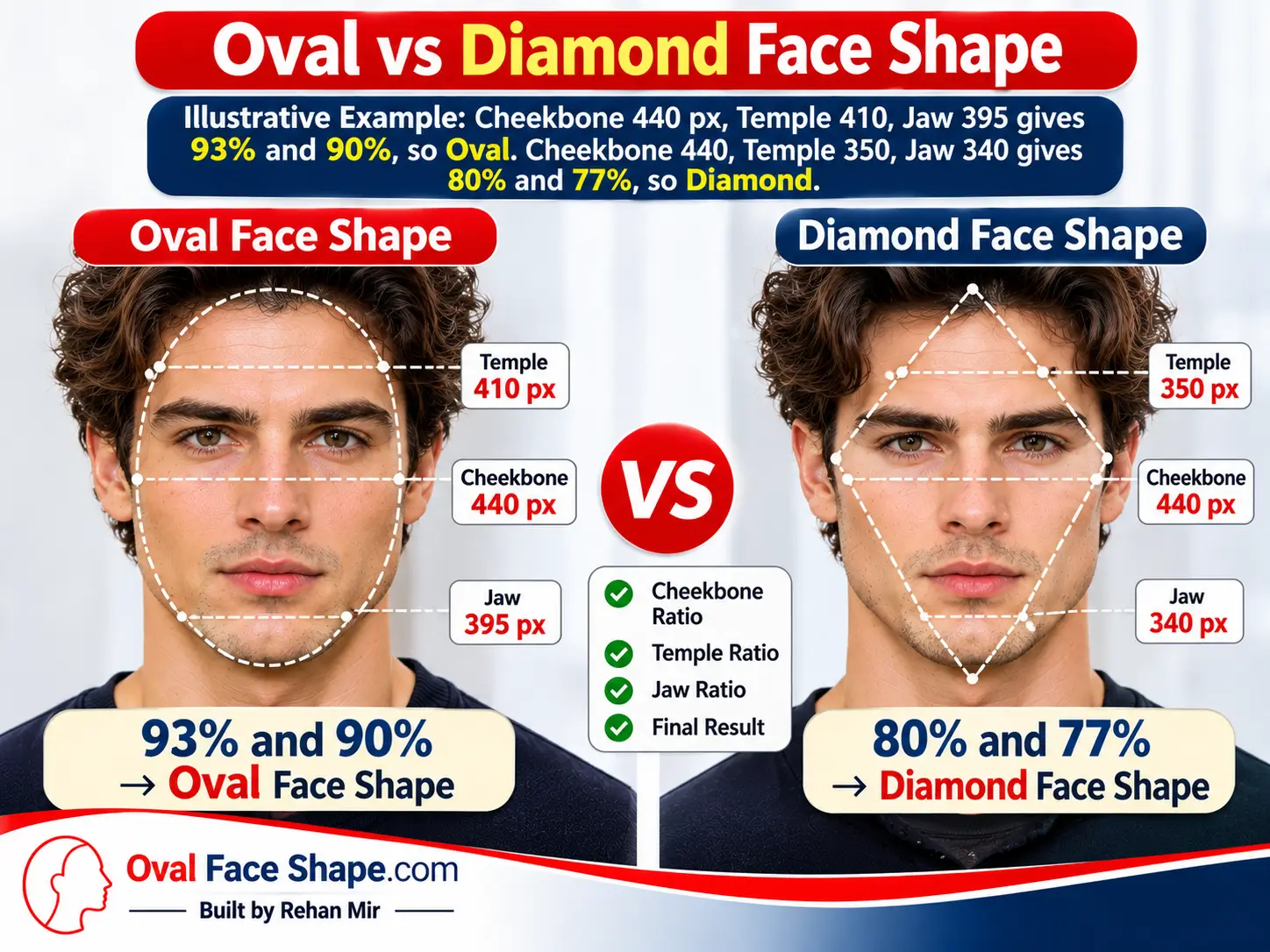
Divide temple width and jaw width by cheekbone width. This is OvalFaceShape.com’s working guideline, not a clinical cutoff:
| Result | Likely label |
|---|---|
| Both 90% or more of cheekbone width, and length ÷ cheekbone width about 1.3–1.5 | Oval |
| Both under about 85% of cheekbone width | Diamond |
| In between, or one of each | Borderline: use the stability check below |
Quick decision path:
- Are your cheekbones clearly the widest span? If no, you’re likely oval or another shape.
- If yes, do both temples and jaw narrow visibly? If yes, diamond. If the narrowing is slight, oval.
- Is your forehead the widest span? Then check heart, not diamond.
Farkas and colleagues compiled international anthropometric data on facial morphology across ethnic groups. Facial proportions vary by population, so no single universal ratio defines a “standard” face.
Take a Photo That Doesn’t Change the Answer
Camera distance changes the outline you’re measuring. In a study of 30 volunteers, the nose appeared 6.4% longer on 12-inch selfies and 4.3% longer on 18-inch selfies than in standard clinical photographs, and chin length decreased 12% on 12-inch selfies.
The study (Pressler et al., 2022) measured features, not face-shape labels. It still shows why an arm’s-length selfie is a poor measuring photo. plasticsurgery
Setup:
- Stand about five feet from the phone and crop later.
- Hold the camera at eye level.
- Pull hair off the temples and remove glasses.
- Keep your expression neutral with an even front light.
- Take two photos and run the test on both. Keep the label only if it stays the same.
Oval vs Diamond Face Shape for Men and Women
The outline test works the same for both, but different things hide the outline. A beard covers jaw angles, so measure with stubble or from a photo where the jaw edge is visible. Hair covers temples, so pull it back.
| Oval | Diamond | |
|---|---|---|
| Men’s haircut | Textured crop, side part or slick-back keep the balance. Avoid height that stretches the length. | Textured fringe with a mid taper adds forehead width. Avoid bulk at cheek level. |
| Women’s haircut | Long layers, a layered lob or curtain bangs. Avoid heavy side volume. | Side-swept fringe or a chin-length bob adds width at the forehead and jaw. |
| Glasses | Most shapes work. Frame size matters more than shape. | Oval, rimless or browline frames soften the cheekbones. Avoid very narrow frames. |
| Beard | Stubble or short boxed. A long chin beard adds length. | Fuller chin and jawline growth widens the lower face. Avoid cheek bulk with a clean chin. |
These are visual-balance guidelines, not rules. Hair density, texture and growth pattern usually matter more. For full cut libraries, see hairstyles for every face shape and the diamond face shape guide.
Can You Be Both? Nearby Shapes and Mixed Outlines
Many readers aren’t a clean oval or diamond. A pointed chin alone doesn’t make a diamond.
| If you see | Closer to | Where to check |
|---|---|---|
| Forehead widest, narrow chin | Heart | Diamond vs heart |
| Length far exceeds width, straight sides | Oblong | Oval vs oblong |
| Length close to width, full soft jaw | Round | Round face guide |
Borderline faces get different labels from different sources. One guide lists Jennifer Lopez as diamond-shaped, while another lists her among celebrities with an oval face shape.
See celebrities with a diamond face shape for more examples.
Choose the label that stays stable across two photos. If both labels lead you to the same frames or haircut, stop refining.
What the Label Can and Can’t Tell You?
No reliable research ranks oval against diamond as the more attractive shape. These are grooming labels, not anatomical classes. Some guides call diamond less common than oval, but I couldn’t find population data behind that claim.
Use the label to predict where a style adds width or length, and your goal decides whether that effect helps.
Key Takeaways
- Oval has a smooth curve with near-equal widths. Diamond has a clear cheekbone peak with narrower temples and jaw.
- Compare temple and jaw width to cheekbone width, not face length.
- Photo distance changes results, so shoot from about five feet and test twice.
- Pointed chin alone is not diamond. A wider forehead points to heart.
- Style for the effect you want, and stop once the label no longer changes your choice.
FAQs
Is a diamond or oval face more attractive? (supplied)
Neither. No reliable research ranks these labels, and attractiveness depends on many features and personal taste.
Does a pointed chin mean I have a diamond face?
No. Check whether your cheekbones are the widest span. If your forehead is widest, it’s likely heart-shaped.
Can I be both oval and diamond?
Yes, borderline outlines are common. Keep the label that holds across two consistent photos.
What is the difference between diamond and heart?
Diamond is widest at the cheekbones. Heart is widest at the forehead.
Is knowing my face shape still worth it?
Yes, as a shortcut for narrowing cuts, frames and beard styles. It isn’t a rule.
How do I check without a tape measure?
Take a front-on photo from five feet away. Compare temple, cheekbone and jaw widths on screen.
Is diamond rarer than oval?
Some guides say so, but I found no solid population data.
Next step: Run your photo through the Face Shape Detector for a ratio read-out, then open the guide that matches your result.