
Quick Answer:
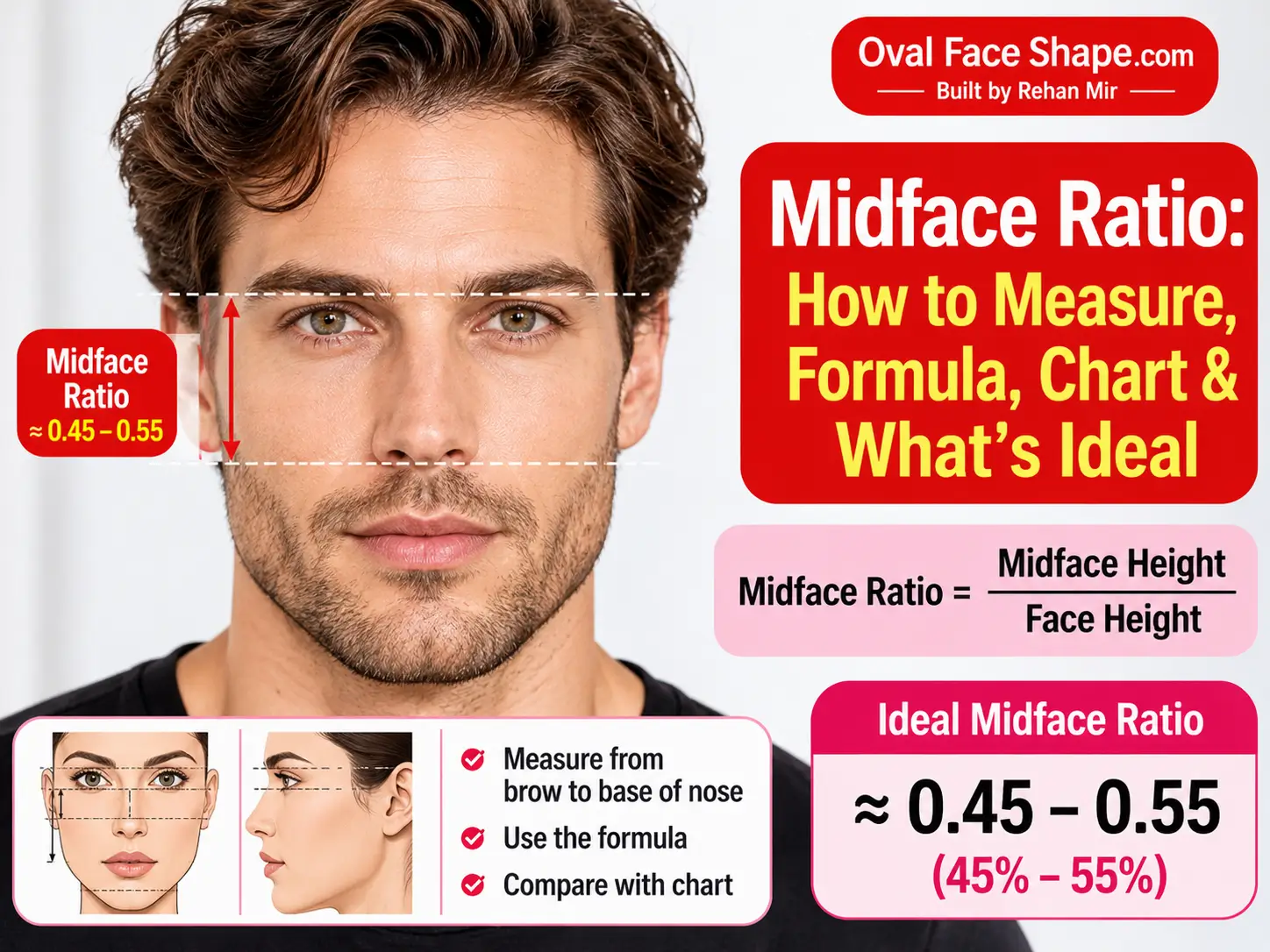
Midface ratio = distance between your pupils ÷ distance from the pupil line to the upper lip. Around 1.0 is the popular “ideal”, but it’s a looksmaxxing convention, not a research-backed standard.
By Muhammad Rehan Iqbal, Founder and Developer of OvalFaceShape.com, specializing in face shape analysis, interactive facial assessment tools, and educational styling guides.
Your midface ratio is your interpupillary distance (IPD) divided by the distance from your pupil line to your upper lip. A result near 1.0 means the two distances are about equal. Calculators and looksmax guides call that “ideal,” but it’s an online convention, not a medical or research-backed standard.
Who this guide is for:
This guide is for anyone who got a number from a calculator, scanner or looksmax thread and wants to understand it before acting. OvalFaceShape.com treats the midface ratio as one facial proportion that informs hair, glasses and facial-hair choices, not as a beauty verdict. Surgical planning is outside its scope.
What Is the Midface Ratio?
The midface ratio compares eye spacing with midface height. Here, midface height is the vertical distance from the pupil line to the top of the upper lip. Above 1.0, the eyes sit wide relative to that height and the midface reads compact. Below 1.0, it reads longer.
Some calculators flip the formula (height ÷ IPD), which reverses the direction. A 0.95 in the standard version is about 1.05 in the flipped one. Check which version a tool uses before comparing your number to any chart.
Clinical research on midface position relies on cephalometric (X-ray) landmarks (Chalala & Ghafari, PeerJ). Those are not the pupil and lip points used here, so this ratio is an online convention rather than a surgical measurement.
Midface Ratio Formula and Measurement Steps
Midface ratio = IPD ÷ pupil-to-upper-lip distance:
- Take the photo. Shoot straight on at eye level, with a neutral face and closed lips, from a few feet away. Close selfies distort the nose and central face (Ward et al., JAMA Facial Plastic Surgery, 2018).
- Mark each pupil center and draw a horizontal line through both.
- Measure IPD along that line.
- Measure straight down from the line to the top edge of the upper lip.
- Divide IPD by that height, in the same units.
Example: IPD 324 px ÷ height 281 px = 1.15, a compact midface by the usual bands.
Calculator, Scanner or Test: Photo vs. Manual
A midface ratio calculator or scanner places the landmarks for you, which is faster. The method is the same whether you follow a looksmax tutorial, a calculator photo tool or a ruler: pupil line, upper lip, one photo. Four things make results drift:
- Formula version: different tools may divide in different directions.
- Landmark placement: with a 300 px IPD, a lip point placed 10 px too low moves 1.00 to about 0.97.
- Expression: a smile lifts the upper lip and shortens the height.
- Tilt and lens: head angle and close-up distortion change the numbers.
Measure two or three photos and average them. To see where the ratio sits within your overall proportions, run the Golden Ratio face Detector or Face Shape Detector on OvalFaceShape.com.
Midface Ratio Chart: Ideal, Perfect, Good and Bad
The ideal midface ratio is usually quoted as about 1.0 (a 1:1 ratio), sometimes widened to roughly 0.9–1.1. No study has set a cutoff for a good, perfect or bad ratio.
| Midface ratio (IPD ÷ height) | How it’s usually described online |
|---|---|
| 1.10 and above | Short or very compact |
| 1.00–1.10 | Balanced to compact (the “ideal” zone) |
| 0.90–0.99 | Slightly long |
| Below 0.90 | Long |
Read this as a summary of online talk, not a scale. Sources disagree: some put the ideal at 1.0–1.05, and a widely repeated forum rule avoids anything below 0.9 or above 1.1. The same number can be “ideal” on one list and outside the range on another.
Research points to averageness rather than a magic number. One study found faces rated most attractive when eye-to-mouth distance was about 36% of face length and eye spacing about 46% of face width (Pallett, Link & Lee, Vision Research, 2010). Those are different measurements, and only the faces tested apply. The finding does not show that 1.0 is best or that a shorter midface always wins.
A “bad” long midface is a forum label, not a diagnosis. If a long lower face comes with bite problems, jaw pain or breathing trouble, an orthodontist or oral and maxillofacial surgeon can assess it.
Midface Ratio vs. Facial Thirds, Face Length-to-Width and Midface-to-Chin
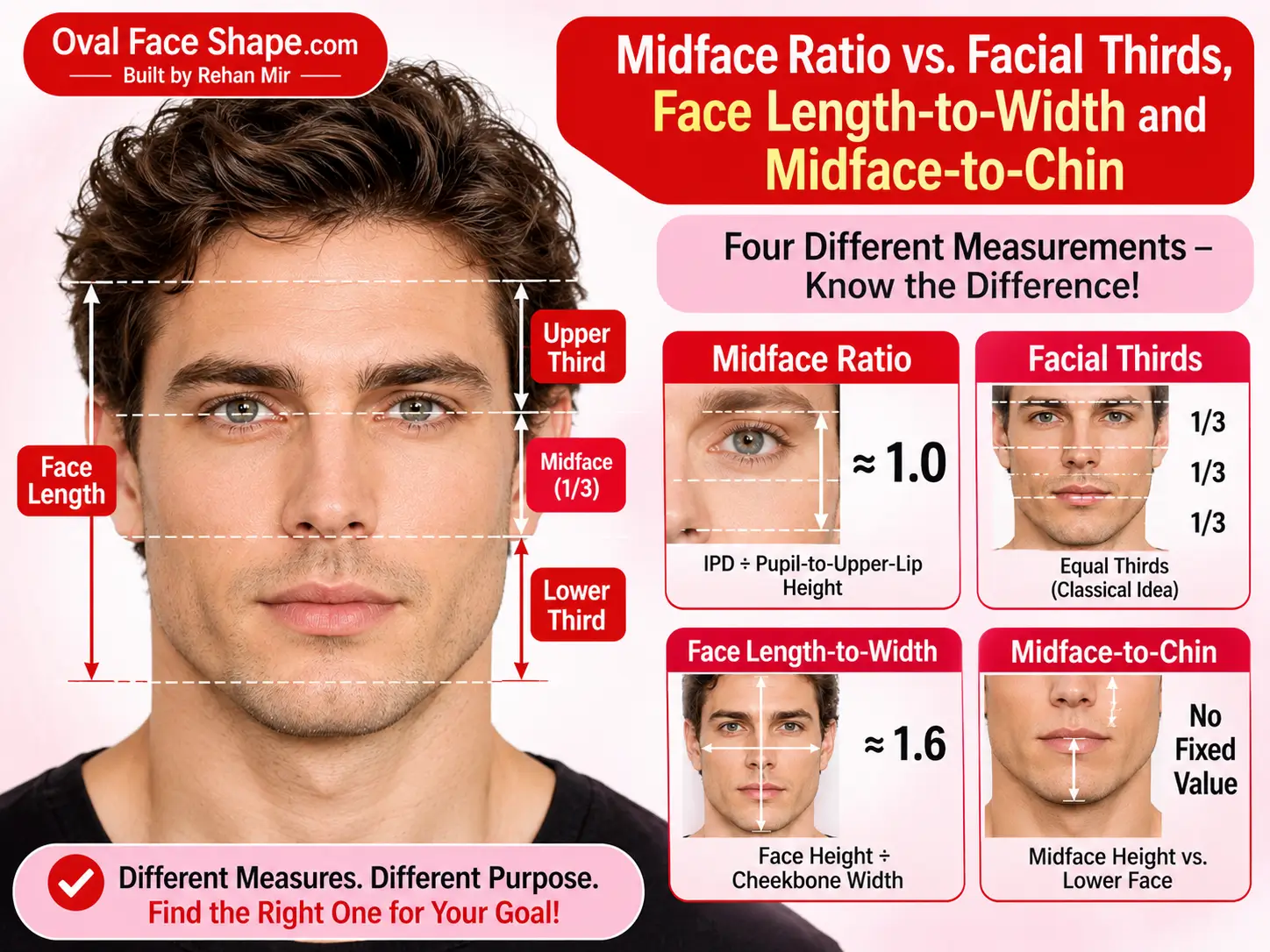
Four different measurements get mixed up in searches. Each uses different landmarks:
| Measure | Compares | Common reference |
|---|---|---|
| Midface ratio | IPD ÷ pupil-to-upper-lip height | About 1.0 (online convention) |
| Facial thirds (“1/3 rule”) | Heights of upper, middle and lower face | Equal thirds (a classical idea; real faces vary) |
| Face length-to-width | Face height ÷ cheekbone width | 1.6 golden-ratio benchmark |
| Midface-to-chin | Midface height vs. lower face | No research benchmark found |
So “1.6” and “1:3” are not midface ratios. 1.6 refers to face length against width. OvalFaceShape.com’s face shape guides use that length-to-width logic. If your whole face reads long, compare it with the oblong face shape guide.
Improving a Long Midface: What Changes the Look
You can’t change your IPD, and bone proportions only change with surgery. What you can change is how the midface reads. These are styling principles, not measured results, and none of them changes the number.
- Glasses: a strong horizontal top line adds width across the middle of the face. See glasses by face shape.
- Hair: side volume and bangs shorten the visual height, while crown height lengthens it. See hairstyles by face shape.
- Facial hair: a mustache visually breaks up the space between nose and lip. See beard styles by face shape.
- Brows and blush: brow shape shifts where the eye line seems to sit, and blush swept across the cheeks pulls the eye sideways.
Medical options change actual proportions or how they read. They include rhinoplasty, lip lift, jaw (orthognathic) surgery, cheek or under-eye implants and fillers. Each carries real risk, cost and recovery time, so start with a board-certified plastic surgeon or an oral and maxillofacial surgeon.
Several popular fixes lack support. The American Association of Orthodontists says no research shows mewing benefits the jawline, and it warns that forced tongue positions can disrupt tooth alignment. Facial exercises can’t change bone or eye spacing, and “bone smashing” has no scientific support and can injure you.
If measuring your face is taking over, with repeated photo checks or avoiding mirrors, talk to a doctor or mental-health professional before considering any procedure.
Key Takeaways
- Midface ratio = IPD ÷ pupil-to-upper-lip distance. About 1.0 is the popular reference.
- “Ideal” bands are online conventions, and they disagree with each other.
- Check the formula direction and photo quality before trusting a number.
- 1.6 and 1:3 belong to other measurements.
- Styling changes how the midface reads. Only surgery changes proportions.
Next step: After measuring, run the Face Shape Detector and open the matching glasses guide.
FAQ’s
What is a good midface ratio?
Most guides call about 1.0 (1:1) good, with forum ranges of roughly 0.9–1.1. These are online conventions, and no study has defined a good ratio.
How do I calculate my midface ratio?
Divide your pupil-to-pupil distance by the pupil-line-to-upper-lip distance, from one straight-on photo in the same units. For example, 324 ÷ 281 = 1.15.
Is 1.6 face ratio good?
1.6 is the golden-ratio benchmark for face length ÷ width, not the midface ratio. One study found attractiveness peaked at average proportions, not at 1.618.
How to fix a bad midface ratio?
You can’t change it without surgery. Glasses, bangs, side volume, facial hair and blush change how it reads. Consider medical options only after a specialist consultation.
Is the midface ratio still worth measuring?
Yes, as one proportion that informs styling. No, as a beauty score. It ignores jaw, chin, brows and skin.
Is the midface ratio the same as facial thirds?
No. Facial thirds compare the heights of the upper, middle and lower face. The midface ratio compares eye spacing with pupil-to-lip height.
Can ChatGPT or a free scanner measure my midface ratio?
A landmark-based calculator measures distances. A chatbot estimates by eye and may give different numbers for the same photo. Average two or three photos either way.