
Quick Answer:
Oval and oblong face shapes suit similar hairstyles. Keep side width and low-to-medium height. Try crew cuts, side quiffs, and side parts. Avoid tall styles and tight skin fades that make the face look longer.
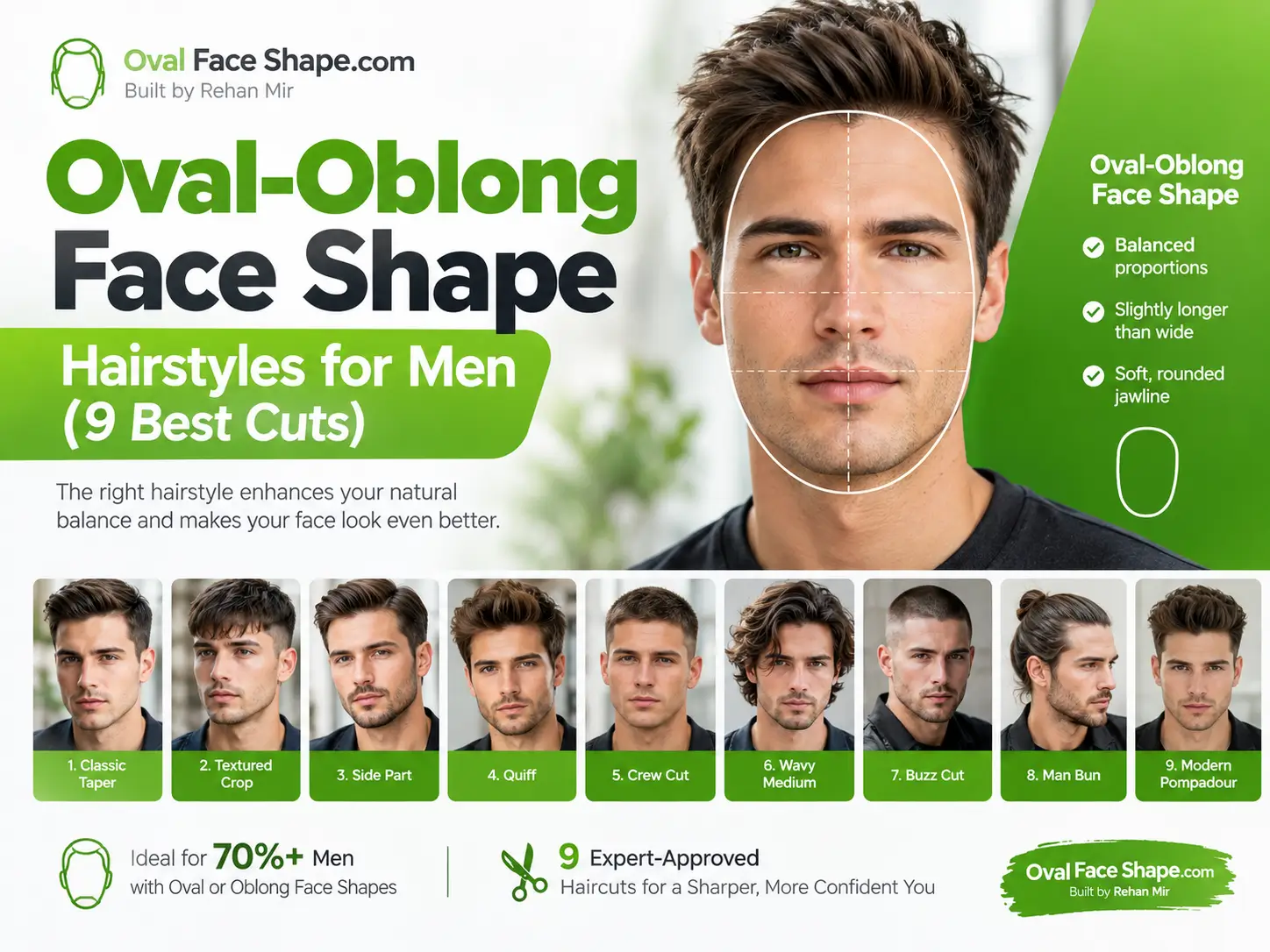
An oval-oblong face is a borderline face shape where face length divided by cheekbone width falls between about 1.45 and 1.55. It combines the cheekbone taper of an oval face with the extra length of an oblong one. This guide matches men’s haircuts, hair lengths, and beard lengths to that blend.
Who this guide is for:
Men whose face is longer than a pure oval but lacks the flat, even sides of a true oblong face. It’s built for choosing a cut before a barber appointment when you’re unsure which set of rules applies to you.
This guide is styling guidance, not a medical or diagnostic assessment. Hairstyle suggestions are guides, not rules.
What Is an Oval-Oblong Face Shape?
Face shape here is face length (hairline to chin) divided by cheekbone (bizygomatic) width. A pure oval sits at about 1.30–1.50, and an oblong face starts around 1.50. The blend is the band straddling that line.
| Zone | Length ÷ cheekbone width | Styling rule |
|---|---|---|
| Clearly oval | ~1.30–1.44 | Most cuts work |
| Oval-oblong blend | ~1.45–1.55 | Add side width, keep the crown restrained |
| Clearly oblong | ~1.56+ | Strict: low crown, width at the sides, light fringe |
Be careful with “ideal ratio” numbers online, because they depend on which width is used. An AI analysis of attractive celebrity faces in Aesthetic Surgery Journal Open Forum (2023) found facial height to jaw width of about 1.57 in men. Against cheekbone width, the same men averaged about 1.39, which is oval territory by the method above. The sample was small (21 men), celebrity-only and one ethnic group. It shows how much the number depends on the measurement, not that attractive faces cluster at the oval-oblong line.
How to Tell If You Have This Blend?
- Your face is clearly longer than wide, but not dramatically so.
- Your cheekbones are slightly wider than your forehead and jaw, rather than perfectly flat like a true oblong face.
- Your measurement lands close to 1.5, not clearly above or below it.
Use a straight-on photo with a neutral expression and your hair pulled back. Shoot from a distance, not a close selfie. Measure hairline to chin and widest cheekbone to cheekbone, divide, and repeat on three photos. Photos shift the number.
University of York research (PeerJ, 2016) found that expression changed width-to-height measurements by more than the differences between people. A separate PLOS ONE study found that shorter focal lengths produced smaller ratios.
Both studies used cheekbone width over upper-face height, a related but different measure, so treat them as a warning about photo error, not as thresholds. If you land at 1.45–1.55, treat it as a zone, not a verdict.
The Styling Principle: Add Width, Allow Some Height
For a true oblong face the rule is strict: avoid height, add width wherever possible. For a pure oval, almost anything works. The blend sits between the two. Side volume, horizontal fringe lines and texture still do the most work, but the mild cheekbone taper means you can carry a little crown height that a strict oblong face can’t.
| Decision | Oval | Oval-oblong | Oblong |
|---|---|---|---|
| Crown height | Free | Moderate | Low |
| Taper | Any | Low to mid | Low |
| Fringe | Optional | Light fringe helps | Strongly helpful |
| Slick-back | Fine | Only with textured sides | Avoid |
| Beard | Any length | Short to medium, fuller at the sides | Boxed, jaw width |
For a head-to-head breakdown, see oval vs oblong face shape.
Best Hairstyles for an Oval-Oblong Face Shape
Crew Cut (Low-to-Mid Taper)
The most reliable option for this blend. The taper removes bulk gradually while leaving enough length on top for texture, which keeps temple width. Ask for a low-to-mid taper rather than a high or skin fade. Any barber can do it in one visit.
Long Crew Cut
More length on top than a standard crew, still short at the sides. It gives you room for texture and slight side volume without tipping into height, and suits the blend better than a very short crew.
Classic Crew Cut
Short and uniform, and the lowest-maintenance choice. It doesn’t add height in either direction. The trade-off is less width-adding texture, so it suits men who value simplicity over active proportion correction.
Textured Side Quiff (Moderate Height)
Kept at moderate height and swept to the side rather than straight up, it adds horizontal movement. The cheekbone width absorbs the small amount of added height. A full pompadour is a step too far.
Classic Side Part
At medium length (roughly 4–6 cm on top), it redirects visual movement horizontally and works from the office to casual settings. It’s the closest thing to a universal choice here.
Curtain Fringe or Center Part With Volume
Hair swept outward from a center or near-center part creates strong horizontal movement at the upper face. It counteracts the length the oblong component adds and complements the cheekbone structure.
French Crop With Light Fringe
A short fringe adds a horizontal line at the forehead. Because the forehead isn’t the main concern here as it is on a true oblong face, the fringe can stay lighter and less full.
Medium Textured Flow
Medium hair gives you more width control than short hair. Hair at roughly ear-length with natural movement adds side volume that breaks up length. Light layers do the same job with less weight.
Discover the best hairstyles for oval face shapes for men and women in our complete styling guide.
| Style | Best for | Maintenance |
|---|---|---|
| Crew cut (low-to-mid taper) | Most oval-oblong men | Low |
| Long crew cut | More texture without added height | Low–medium |
| Classic crew cut | Simplicity over active correction | Very low |
| Textured side quiff | Some crown height, professional look | Medium |
| Side part | Universal, work-appropriate | Low |
| Curtain fringe | Strong horizontal emphasis | Medium |
| French crop | Lighter fringe, high forehead | Low–medium |
| Medium textured flow | Natural wave, more side volume | Medium |
See which real faces fall near this zone in celebrities with oblong face shapes and celebrities with oval face shapes.
Pick by Hair Type and Hairline
| Your hair | Best fit | Watch out for |
|---|---|---|
| Fine or thin | Long crew or textured crop, matte product, low taper | Slicked-flat styles that expose length |
| Thick, straight | Side part or textured quiff, with texturizing | Bulk piling up on top |
| Wavy or curly | Medium flow or curtain fringe, with volume kept at the sides | Skin-tight sides with a tall top |
| High forehead or receding | French crop with light fringe, side part | Hair swept straight back |
What Should You Ask Your Barber for an Oval-Oblong Face Shape?
| Ask for | Why | Avoid saying |
|---|---|---|
| “Low-to-mid taper, not a skin fade” | Keeps temple width | “High and tight” |
| “Keep length on top, textured, swept sideways” | Horizontal movement, no extra height | “As tall as it goes” |
| “A light, broken-up fringe” | Shortens the visible forehead | A heavy, blunt fringe |
| “Leave the sides a little fuller” | Preserves width | “Take it all off the sides” |
Hairstyles to Avoid for an Oval-Oblong Face Shape
Tall pompadours and flat slick-backs with tight sides work against the oblong side of the blend. A high fade is the riskiest taper because it removes temple width. It can work if the top stays textured and sweeps sideways, but a low or mid taper is the safer default.
Long, flat, center-parted hair with no texture adds length with no compensating width. A tight skin fade with no top texture removes the exact side bulk this shape benefits from.
Beard Pairings for an Oval-Oblong Face
A full or short boxed beard that adds width at the jawline pairs well, as it does for a true oblong face. Because of the oval component, you have slightly more room than a strict oblong face to wear a medium-length beard.
Keep it fuller at the sides of the jaw rather than long at the chin, since a long, pointed chin beard adds length you don’t need.
For a full breakdown by jaw shape, see beard styles by face shape.
Key Takeaways
- The blend sits at about 1.45–1.55 length-to-cheekbone-width.
- Crew cuts with a low-to-mid taper are the most reliable cut family.
- Moderate crown height works, but tall, flat or fully slicked styles still work against this shape.
- Medium hair with texture is a strong alternative to short cuts.
- Treat your measurement as a zone, since photos shift the number.
- A boxed or full beard that adds jaw width pairs with any cut above.
FAQs
What is an oval-oblong face shape?
A blended shape where your face is longer than a classic oval (about 1.45–1.55 length-to-cheekbone-width) but still shows a mild cheekbone taper that a true oblong face lacks.
Is a crew cut with a fade a good choice?
Yes, as a low-to-mid taper. It’s easy to request and keeps temple width.
Can an oval-oblong face wear a high fade?
Sometimes. It works when the top is textured and swept sideways. A low or mid taper is the safer default.
Am I oval or oblong if I measure about 1.5?
You’re right on the line. Use the advice for both shapes. The oval vs oblong guide explains the differences.
What works for thin or fine hair?
A long crew cut or textured crop with a low taper and matte product gives the top structure.
Is an oval-oblong face attractive?
No face shape is objectively better. Proportions are style variables, and the research above doesn’t rank shapes.
Does weight change which cuts work?
Added facial fullness can soften a longer face slightly, but the underlying bone proportions stay the same, so the same cut family generally still applies.
Not sure exactly where you fall?
Run your photo through the Face Shape Detector to see your ratio before booking a cut.