
Quick Answer:
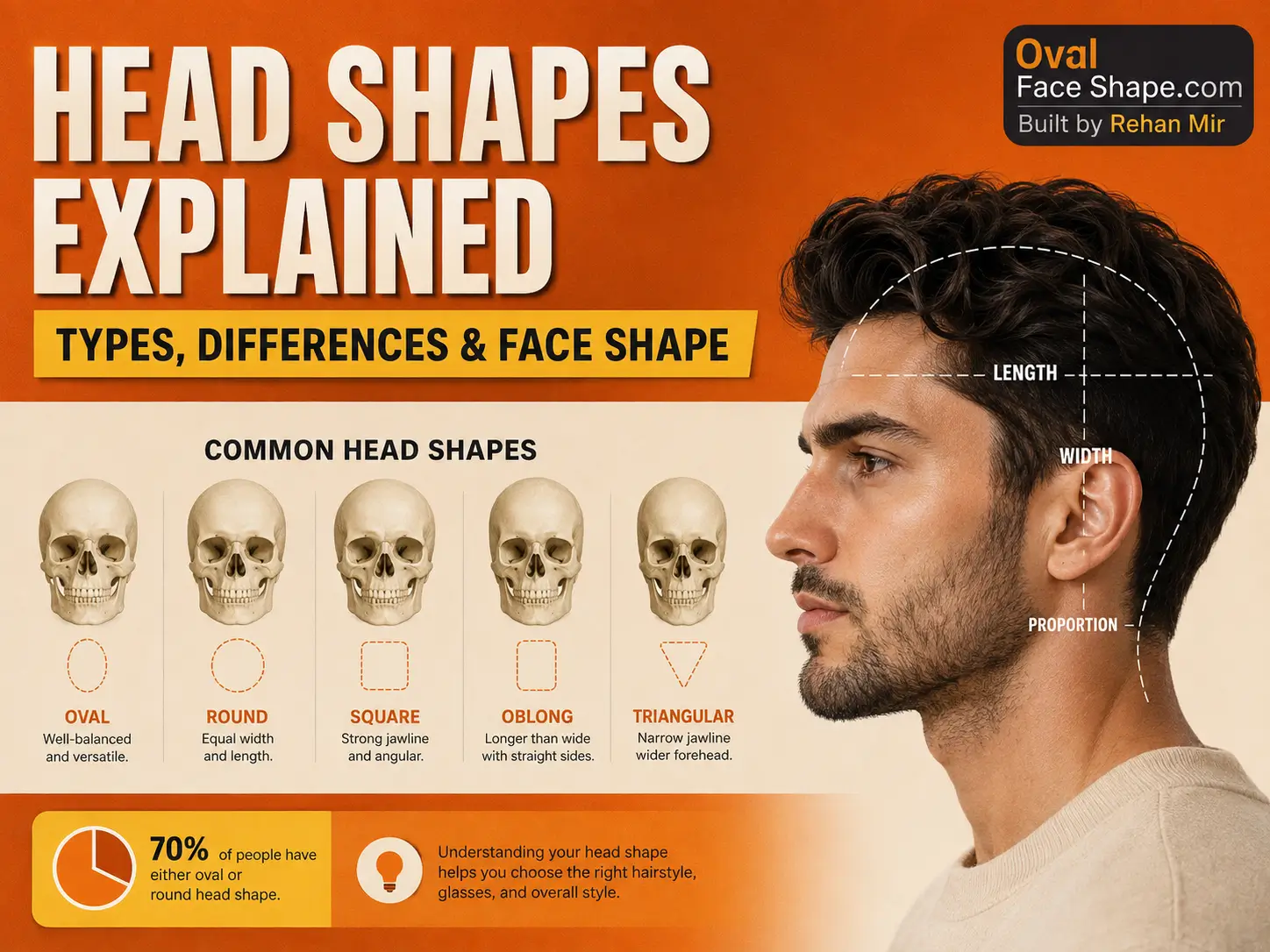
Head shape is the 3D form of the skull, while face shape is the 2D outline of the face. Round, long, and flat-back describe head shapes; oval, diamond, triangle, and other classifications make up the 10 face shapes covered on this site.
If you searched “head shapes explained” hoping to find out whether you have a diamond, triangle, or rectangle head, you’re not alone—and you’re most likely asking about your face shape.
Who this guide is for:
This guide is for two different readers: the person trying to identify their face shape who used “head shape” as shorthand, and the smaller group genuinely asking about skull geometry for a hat, helmet, or very short haircut. Both get a straight answer below.
Head Shape vs. Face Shape: The Distinction That Matters
Head shape describes the 3D form of your skull, best seen from directly above or behind. Face shape describes the 2D outline of your face from the front — the system of categories like oval, round, square, heart, diamond, triangle, and rectangle that this site covers.
They’re related but not interchangeable. Your face shape is decided by the width of your forehead, cheekbones, and jaw plus your face length.
Your head shape is decided by how your skull is proportioned when viewed from a completely different angle.
The Real Head Shape Types (and the Classification Almost Nobody Cites)
Unlike casual barber vocabulary, head shape actually does have a standardized scientific classification:
The cephalic index, introduced by Swedish anatomist Anders Retzius in the 1840s and still used in physical anthropology and craniofacial research today.
It’s calculated as skull width divided by skull length, multiplied by 100.
| Type | Cephalic index | What it means |
|---|---|---|
| Dolichocephalic | Below 75 | Long, narrow skull — longer front-to-back than side-to-side |
| Mesocephalic | 75–80 | Balanced proportions — the most common range in many populations |
| Brachycephalic | Above 80 | Short, broad skull — wider than it is long |
A 2024 review in the Journal of Prosthetics and Orthotics notes the cephalic index’s exact boundaries have shifted since Retzius first proposed them and were always somewhat arbitrary — but the three-way classification itself remains the standard reference point in craniofacial anatomy.
This is the real head-shape system; everyday descriptions like “flat back” or “peaked crown” are practical shorthand barbers and hat-fitters use, not a competing scientific system.
Why “Diamond,” “Triangle,” and “Rectangle” Head Shape Usually Means Face Shape?
Here’s the direct redirect:
Diamond, triangle, and rectangle are not skull categories in the cephalic index or anywhere else in craniofacial literature. They’re face-shape categories.
- “Diamond head shape” → you’re describing a diamond face shape: widest at the cheekbones, narrower at the forehead and jaw. See the Diamond Face Shape guide for full identification and styling.
- “Triangle head shape” → you mean a triangle face shape: jaw widest, forehead narrowest. Check the Triangle Face Shape guide.
- “Rectangle head shape” or “rectangle shape head” → you’re looking for a rectangle face shape: long, with forehead, cheekbones, and jaw running close to parallel and a squarer jaw than an oval face. The Rectangle Face Shape guide covers this in full, including how it differs for a rectangle face shape female profile versus a more angular male one.
- “What is oblong face shape” / “what is an oblong face” → oblong is the more elongated, slightly softer-jawed cousin of rectangle, covered separately in the Oblong Face Shape guide, including notes specific to oblong face shape men.
If any of those descriptions sound like you, the fastest accurate path is the Face Shape Detector, which uses facial landmark analysis rather than guesswork — a better starting point than a face shape scanner that just asks you to eyeball a mirror.
How to Check Your Actual Head Shapes at Home?
If you genuinely mean skull shape — for a bike helmet, a hat, or a very short buzz cut — two low-effort checks work without any equipment:
- Take a top-view photo. Hold your phone directly above your head, or have someone else take the shot. This shows whether your skull reads round or long most clearly.
- Feel the back of your skull with a flat hand. A flatter feel toward the base suggests a brachycephalic tendency; a rounder feel suggests otherwise.
Neither test replaces a professional helmet-fitting or a barber’s in-person read, but both are enough to have an informed conversation with either.
When Head Shape Actually Affects Styling?
At any real hair length, your hair itself defines the outline people see, and the skull underneath barely registers. Head shape only becomes visually relevant at a very short buzz or crop, where there’s no length left to disguise a flat back or a peaked crown.
This is the one place head shape has a genuine styling consequence — separate entirely from face shape, which affects styling at every hair length.
“Want to find the perfect hairstyle for your face shape? Explore our comprehensive guide to discover the most flattering hairstyles for every face shape.”
A Note on Babies and Flat Spots!
If you’re here because of an infant’s head shape, this article isn’t the right resource. A flattened area from consistent sleep position — sometimes called positional plagiocephaly — is a real, common, and generally treatable pediatric topic. Speak to your pediatrician rather than relying on any website, including this one.
Key Takeaways
- Head shape (skull, 3D) and face shape (facial outline, 2D) are different measurements that share confusing vocabulary.
- The real scientific head-shape classification is the cephalic index: dolichocephalic, mesocephalic, brachycephalic — not diamond, triangle, or rectangle.
- If you searched “diamond,” “triangle,” or “rectangle” head shape, you almost certainly want the matching face-shape guide instead.
- Head shape mainly matters for hat/helmet fit and very short haircuts; face shape matters for hairstyle and glasses choices at any length.
- The Face Shape Detector is the accurate starting point if you’re not sure which face shape you actually have.
FAQs
Is head shapes the same as face shape?
No. Head shape is the 3D form of your skull, usually assessed from above or behind. Face shape is the 2D outline of your face from the front. They’re related to the same skeleton but measured completely differently.
Is the head shape classification (cephalic index) still relevant in 2026?
Yes, in anthropology, forensic science, and craniofacial research, though a 2024 journal review notes its exact numeric boundaries have been revised over time.
For everyday hairstyling purposes, most barbers still use practical terms like “round” or “flat back” rather than the formal index.
What’s the difference between a diamond head shape and a diamond face shape?
There’s no standard “diamond head shape” in craniofacial classification — diamond is a face-shape term, describing a face that’s widest at the cheekbones.
If you searched for diamond head shape, the Diamond Face Shape guide is almost certainly what you’re looking for.
How can I check my head shape at home?
Take a photo from directly above your head, or feel the back of your skull with a flat hand. Both give a rough read on whether it’s round, long, or flatter at the back — enough for a hat or helmet conversation, though not a substitute for a professional fitting.
Does head shape affect which hairstyle suits me?
Mainly at very short lengths. Once hair has real length, it defines the outline itself, and head shape underneath has little visible effect. Face shape, by contrast, affects hairstyle choice at almost any length.
Can head shape change as an adult?
The adult skull’s bony proportions are essentially fixed — head shape doesn’t meaningfully change the way soft tissue can. This is different from infancy, when a baby’s skull is still soft and can be affected by sleep position, which is a matter for a pediatrician, not a styling question.