
Quick Answer:
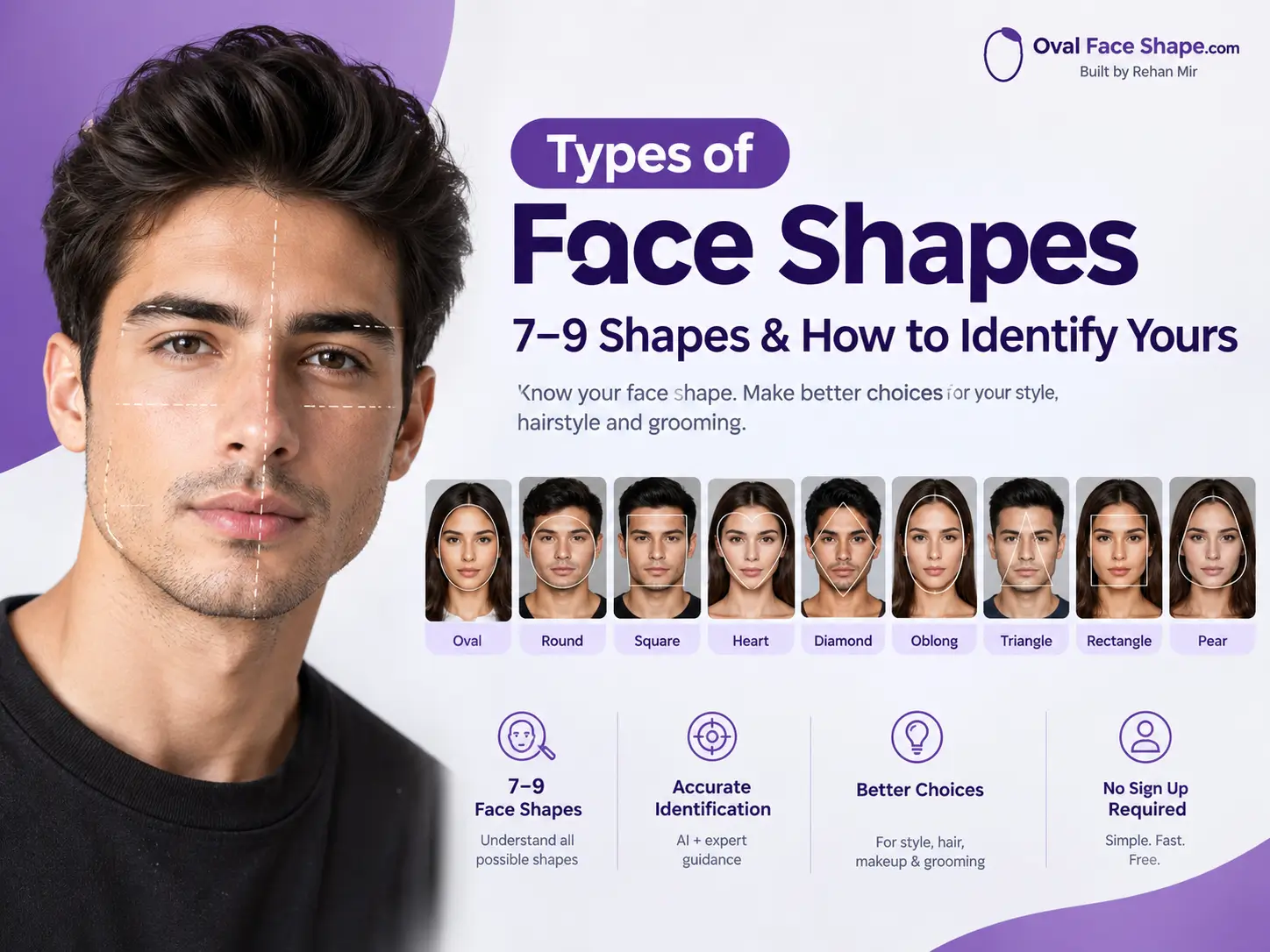
There are 7 core face shapes — oval, round, square, rectangle, heart, diamond, and triangle — plus oblong, pear, and inverted triangle in extended systems. Shape is determined by comparing forehead, cheekbone, and jaw width to face length.
What Determines a Face Shape?
A face shape isn’t a subjective impression — it’s a ratio. Facial-analysis systems compare four measurements: forehead width, cheekbone width, jawline width, and total face length.
Where those numbers land relative to each other determines which recognized face shape you fall into, and the underlying logic is the same whether you’re using a tape measure, the OvalFaceShape.com Face Shape Detector, or a stylist’s trained eye.
This matters because face shape is the foundation OvalFaceShape.com’s styling guides build on — before choosing a hairstyle, glasses, or beard shape, you need an accurate read on which category actually fits.
The 7 Core Face Shapes!
Most classification systems, including the framework the Vision Council of America helped popularize for eyewear fitting, converge on seven base shapes.
| Shape | Widest point | Jaw | Length vs. width |
|---|---|---|---|
| Oval | Cheekbones | Gently curved, no sharp angle | ~1.5x width |
| Round | Cheeks | Soft, curved | Roughly equal |
| Square | Jaw ≈ forehead ≈ cheeks | Strong, angular | Roughly equal |
| Rectangle | Jaw ≈ forehead ≈ cheeks | Angular | Notably longer than wide |
| Heart | Forehead | Narrow, tapered chin | Moderate |
| Diamond | Cheekbones | Narrow forehead and jaw | Moderate |
| Triangle | Jaw | Broad, narrows sharply at forehead | Moderate |
Each of these has a dedicated guide on OvalFaceShape.com — see the Oval Face Shape guide as the starting reference, since it’s the baseline most other shapes are compared against.
Why Some Guides List 9 Types Instead of 7?
This is the question most articles skip. The extra shapes usually come from splitting existing categories rather than inventing new ones:
- Oblong is sometimes treated as its own eighth shape — visually close to rectangle, but with a length-to-width ratio that runs 1.6:1 or higher and straighter sides than an oval. OvalFaceShape.com maintains a separate Oblong Face Shape guide because the styling advice genuinely differs.
- Pear (wide jaw, narrow forehead — the inverse of heart) and inverted-triangle (wide forehead, narrow jaw and chin) round out a 9–10 shape system used by more detailed classification sites.
None of this is inconsistent — it’s the difference between a 7-category system built for quick styling decisions and a finer-grained system built for precise identification.
OvalFaceShape.com’s Face Shape Detector uses the finer-grained set, since an AI landmark model can resolve distinctions a glance in the mirror can’t.
How Face Shape Is Actually Measured?
Craniofacial researchers have used standardized landmark measurement — bizygomatic width (cheekbone-to-cheekbone), bigonial width (jaw-to-jaw), and total facial height — for decades to describe facial morphology because anthropometry offers a simple, noninvasive way to describe craniofacial structure without more complex imaging.
Modern AI tools apply the same principle:
A landmark-detection model (like the MediaPipe-based system behind the Face Shape Detector) locates dozens of facial points, then calculates the same width and length ratios a researcher would with calipers. PubMed
Photographic and 3D measurement approaches don’t always agree perfectly, since 2D photo-based facial landmarking loses some of the precision available in 3D craniometric analysis — which is one reason two AI tools can occasionally disagree on a borderline face by a few percentage points. PubMed
Simple Decision Tree: What’s My Face Shape?
- Is your face noticeably longer than it is wide?
- No → go to step 2.
- Yes, with straight sides and similar forehead/jaw width → oblong or rectangle.
- Yes, with tapering sides → oval.
- Are forehead, cheekbone, and jaw width all roughly equal?
- Yes, with a soft jaw → round.
- Yes, with an angular jaw → square.
- Is one area clearly widest?
- Forehead widest, chin narrow → heart.
- Cheekbones widest, forehead and jaw both narrower → diamond.
- Jaw widest, forehead narrow → triangle or pear.
For a precise, numbers-based result rather than a visual guess, the Face Shape Detector runs this same logic against actual landmark measurements.
Face Shape Isn’t Fixed — and That’s Normal
Weight change, aging, and even hairline shifts can move where the “widest point” appears, and most real faces sit close to a boundary between two categories rather than squarely in one.
Treat any result — manual or AI — as styling guidance, not a rigid label.
Key Takeaways
- Face shape is determined by comparing forehead, cheekbone, jaw, and length measurements — not general impression.
- 7 core shapes cover most styling needs; 9–10-shape systems add oblong, pear, and inverted-triangle for finer precision.
- AI and manual measurement can disagree slightly on borderline faces — both use the same underlying landmark logic.
- Use the Face Shape Detector for a ratio-based result before moving to shape-specific styling guides.
FAQs
How do I know my face shape type?
Compare four measurements — forehead width, cheekbone width, jawline width, and total face length — to find your widest point and your length-to-width ratio, or run a photo through the Face Shape Detector for an instant, ratio-based result.
What are the 7 basic face shapes?
Oval, round, square, rectangle, heart, diamond, and triangle. These seven cover the vast majority of styling guidance across hairstyling, eyewear, and grooming.
What kind of face shape is most attractive?
There’s no scientifically settled “most attractive” shape — oval is frequently cited in styling contexts because its balanced proportions suit the widest range of hairstyles and frames, but attractiveness research doesn’t single out one category as universally superior.
What are the 9 types of face shapes?
Oval, round, square, rectangle, heart, diamond, triangle, oblong, and pear (some systems add inverted-triangle as a tenth). These extend the core 7 by separating oblong from rectangle and adding pear/inverted-triangle for cases the core set doesn’t fully capture.
Why do different sites give different face shape counts?
Sites using 6–7 categories are optimizing for quick styling decisions; sites using 9–10 are optimizing for precise identification, usually because they’re built around an AI or measurement tool that can resolve finer distinctions.
3 thoughts on “Types of Face Shapes: 7–9 Shapes & How to Identify Yours”