
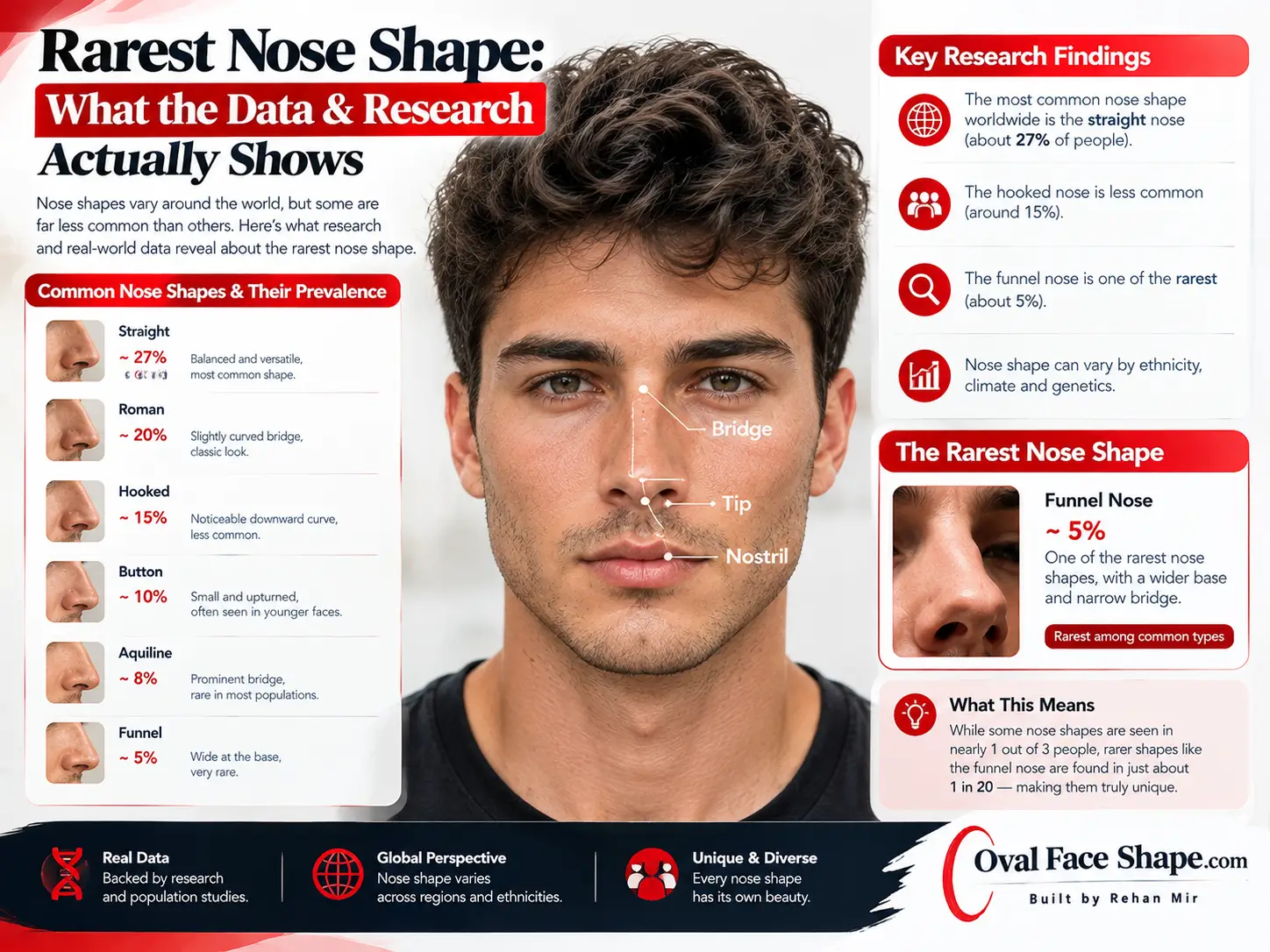
Quick Answer:
No nose shape has a verified world ranking. In the best-known survey of 1,793 noses, the rarest was a single flat, rounded nose (0.05%); fleshy was the most common at 24.2%.
By Muhammad Rehan Iqbal, Founder and Developer of OvalFaceShape.com
A nose shape is the combined profile of the bridge, tip, and nostrils, and OvalFaceShape.com treats it as a feature to read alongside face shape. The rarest nose shape has no verified world ranking, but the only systematic count, Abraham Tamir’s 2011 survey, found one flat, rounded nose in 1,793 faces, while fleshy noses made up 24.2%.
Who this guide is for:
This guide is for curious readers and for anyone identifying their own nose before choosing glasses, makeup or a consultation. It covers what the evidence supports, nose shapes names, and a quick way to find yours. It does not cover surgical technique or face-shape measurement.
What Is the Rarest Nose Shape?
In the only systematic survey, the rarest nose shape is shape 14: A flat, rounded nose that appeared on one face out of 1,793, or 0.05% of the sample. Tamir called it extremely unique. Among the other groups, the least common was shape 4 at 0.45%.
That still does not name the rarest nose shape in the world. One researcher did the sorting, 403 of the 1,793 pictures were artworks, and the photographs came from Holland, Belgium and France. A sample like that cannot rank noses for the whole planet.
Online lists name the Nixon, hawk or Pinocchio nose as rarest, and one clinic page says the bulbous nose is rarest at 0.5%. None shows a method. The clinic claim also collides with Tamir’s data, where the fleshy nose, often described as bulbous, is the most common.
Most Common Nose Shape: The Fleshy Nose
The fleshy nose is the most common nose shape in Tamir’s survey, at 24.2% of noses. It has a large, rounded tip and a prominent overall shape.
For scale, CBS News’s gallery of the survey pairs a different shape with John F. Kennedy and reports it on 16.3% of faces. Those two shapes together covered roughly 40% of the sample, which shows how unevenly noses cluster.
Explore our in-depth guides to the rarest eye shape, rarest face shape, rarest eyelash types, and rarest eyebrow shapes to discover their unique characteristics and understand what makes each one uncommon.
Nose Shapes Names and How Rare Each Is?
| Name | Defining feature | Rarity evidence |
|---|---|---|
| Fleshy (bulbous) | Large, rounded tip | 24.2% in Tamir’s survey |
| Greek (straight) | Straight bridge, no dip or hump | No verified prevalence figure |
| Roman (aquiline, hawk) | Convex bridge with a visible hump | No verified prevalence figure |
| Button (celestial, snub) | Small nose, slightly upturned tip | No verified prevalence figure |
| Saddle | Bridge sits lower than usual | Often linked to injury or medical causes |
| Nixon / Pinocchio | Straight bridge, broader tip | Repeated online, no source |
Names overlap between sources, so treat this table as vocabulary rather than a rulebook. The Roman and aquiline nose guide explains that overlap in detail.
Is the Greek Nose Rare?
A Greek nose has a straight bridge with no dip or hump, and many lists call it rare. No peer-reviewed prevalence figure turned up in the sources reviewed. Treat “rare” here as popular opinion about how often a perfectly straight bridge appears, not a measured rate.
Are Upturned Noses Rare? Button and Celestial Shapes
A button nose is small with a slightly upturned tip, and celestial describes the same upturned tip. Nothing in the verifiable data marks upturned noses as rare. Percentages that circulate for them usually come without a method, so they should not be quoted as fact.
Why Rarity Depends on Where You Look?
Nose shape varies across populations, so a shape common in one region can be uncommon in another. A 2017 PLOS Genetics study by Arslan Zaidi and colleagues found that nostril (nares) width and alar base width differ across populations more than genetic drift alone would predict. Nares width correlated with temperature and absolute humidity, with wider nostrils linked to warmer, more humid ancestral climates.
The authors call this a simplified explanation of a complex history. That is why no single rarest nose shape applies to everyone.
What Shape Is My Nose? How to Find Your Nose Shape?
Muhammad Rehan Iqbal builds facial-assessment tools, and the Face Shape Detector on OvalFaceShape.com classifies whole-face proportions rather than nose type. Nose shape needs a manual check:
- Take a side-profile photo at eye level with a neutral expression. Note whether the bridge is straight, convex or dipped.
- Check the tip from the side: upturned, level or drooping.
- Take a front photo and compare nostril width with the fullness of the tip.
- Match your notes to the table above, and accept a blend if no single name fits.
Many real noses combine features, so a clean label may not exist.
Rare, Attractive and “Perfect” Are Different Questions
Rarity does not make a nose more or less attractive. Attractiveness depends on how a nose fits the rest of the face, and the guide to the best nose shape for an oval face shows how that fit works for one face shape.
“Perfect” is also not a shape you can pick from a list. Only surgery changes nasal structure, so anyone considering it should consult a board-certified facial plastic surgeon. Makeup can shift how a nose reads, but it cannot alter it. That topic needs its own guide.
Key Takeaways
- No nose shape has a verified world ranking.
- In Tamir’s 1,793-nose survey, the rarest shape appeared once (0.05%) and fleshy was most common (24.2%).
- Claims that bulbous is rarest conflict with data showing fleshy, often called bulbous, is most common.
- Rarity depends on population, and climate research links nostril width to ancestral temperature and humidity.
- Greek, Roman and button noses have no verified prevalence figures.
- Identify your own nose manually from a profile and front photo.
FAQs
What is the most attractive nose shape?
No study reviewed here names a single most attractive nose shape for men or women. Ratings depend on how a nose balances with the eyes, lips and chin. A nose that suits one face can look out of balance on another.
What is the lucky nose shape?
No nose shape is scientifically lucky. Face-reading traditions assign meanings to noses, and Tamir cited a book on Chinese face reading with 12 types. No study shows a nose predicts luck.
What is the most wanted nose type?
Clinics name different favourites, such as straight Greek bridges and small upturned tips, and none publish audited request data. Preferences also shift with culture and fashion.
What is a German nose shape?
There is no “German nose.” Nose shape varies widely within every nationality, and the term has no anatomical definition.
Is the bulbous nose the rarest nose shape?
No. Tamir’s survey lists the fleshy nose, often called bulbous, as the most common at 24.2%. Claims that bulbous is rarest at 0.5% appear without a method.
Is the 14-type survey still the best data available?
It is the only numerical survey that surfaced in the sources reviewed, but it has limits: a single sorter, artworks mixed with photographs, and a regional sample. Treat it as a useful snapshot, not a global census.
Can you change your nose shape?
Rhinoplasty can reshape the nose, and a board-certified surgeon can explain what is realistic for your anatomy. Exercises and massage do not alter nasal bone or cartilage.
Next step: Nose shape is one feature, so run the Face Shape Detector to see how your whole face is proportioned.