
Quick answer:
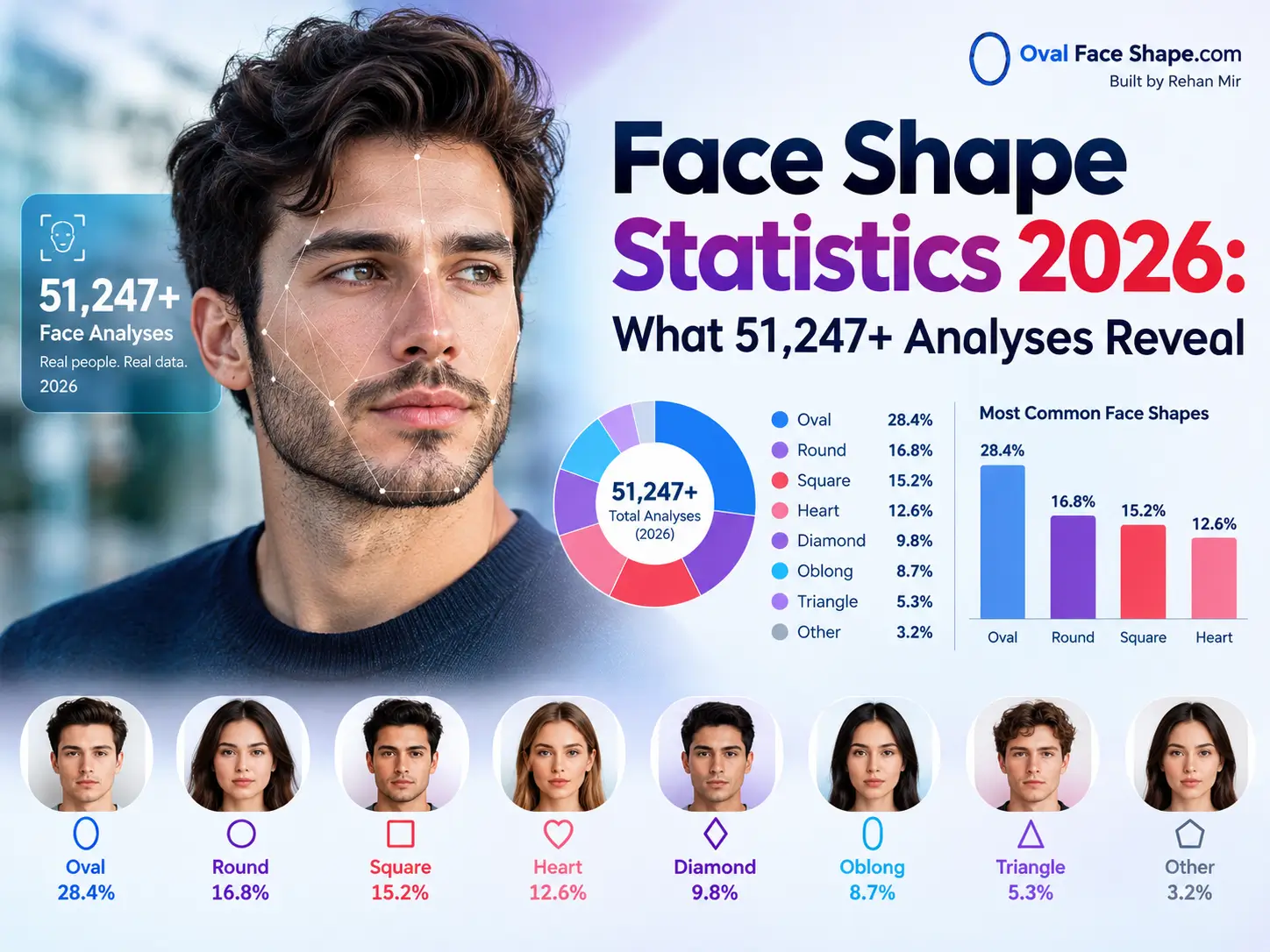
Oval is the most common face shape at 28.4%, while diamond is the rarest at about 5% in 51,247+ analyses. These tool-based results are not universal population statistics, and percentages vary across datasets and classification methods.
Who this guide is for:
If you’ve just checked your face shape, the next question is usually “how common is this?” That’s harder to answer honestly than most sites let on. This page walks through the real numbers, where they come from, and why you’ll see different figures depending on which face shape statistics you’re reading.
Why Face Shape Statistics Differ by Source?
Every published face-shape percentage breakdown you’ll find online comes from one of two places: an AI classifier’s tool-usage logs, or an anthropometric measurement study. Neither is a random population survey, and that matters.
Tool-usage datasets only include people curious enough to try a face-shape analyzer — a self-selected group, not a cross-section of the general public. Published tool-based datasets range from roughly 28% oval up to as high as 46% oval, depending on the site’s sample size and how its classifier is tuned.
A classifier that treats “balanced, no dominant feature” as its default label will always over-report oval, because any borderline or ambiguous face falls into that bucket by design.
Anthropometric research — measuring real facial landmarks rather than classifying photos — gives a narrower, more stable picture. The foundational reference in this field remains facial-proportion research, which puts the ideal “oval” length-to-width ratio at roughly 1.3 to 1.5, a range still used as the baseline in most modern face-shape classifiers today.
The honest takeaway:
There is no single, universally agreed face-shape percentage breakdown. Treat any one number as indicative of that source’s sample, not a global fact.
Face Shape Distribution: Comparison Table
| Face shape | Typical reported range | General note |
|---|---|---|
| Oval | 28–46% | Consistently the most-reported shape; also the classifier’s frequent “default” label |
| Oblong | 14–22% | Second most common in most datasets |
| Round | 9–17% | Range varies most by classifier threshold |
| Heart | 7–19% | Higher in datasets that separate heart from oval more strictly |
| Square | 1–13% | Widest range across sources |
| Diamond | 5–22% | Reported as rare in some datasets, moderately common in others |
| Triangle | under 1–9% | Consistently the rarest or second-rarest in every dataset reviewed |
Ranges reflect the spread across multiple published tool-usage datasets and anthropometric guidance reviewed for this page, not one single source. Want your own data point instead of a range? The Face Shape Detector gives you a measured ratio in seconds.
Face Shape Statistics by Gender: What the Data Shows
Every dataset reviewed for this page that reported a gender split found the same directional pattern, even where the exact percentages differed: heart-shaped results are more frequently reported for women, while square and triangle results are more frequently reported for men.
This tracks with basic anthropometry — average jaw width relative to face width tends to run higher in men, which pushes more male faces toward square or triangle classifications, while a proportionally narrower jaw relative to cheekbone width is more common in female face shape results, which favors heart classifications.
Oval remains the most-reported shape for both men’s face shapes and women’s in every dataset checked; it isn’t a shape unique to one gender.
The Most Attractive Face Shape, According to Research
Prevalence and attractiveness are two different questions, and mixing them is where a lot of guides go wrong. On prevalence, oval wins by a wide margin. On attractiveness, the picture is more mixed.
One of the more frequently cited data points comes from a survey of 1,000 UK cosmetic-surgery patients by Dr. Julian De Silva of the Centre for Advanced Facial Cosmetic and Plastic Surgery, which found diamond was the most-requested face shape among patients, with oval close behind. That’s a survey of people actively seeking a specific look, not a general-population beauty study — another sample-bias caveat worth carrying forward.
Broader attractiveness research points away from shape category entirely. Averageness and symmetry, not a specific shape label, are what’s consistently linked to perceived attractiveness across faces.
In other words:
The most “desirable” face shape depends heavily on who’s being asked and why, and no single shape has a scientific claim to being objectively best.
Which Face Shape Is Rarest?
Triangle is the shape most consistently reported as rarest across the datasets reviewed here, typically landing under 10% and, in several classifier-based datasets, under 1%.
Diamond — a narrow forehead, dramatic cheekbones, and a narrow chin and jawline — is the next most commonly cited as rare, though its reported share varies more by source than triangle’s does.
Curious about which face shape is the rarest? Read our in-depth guide to the Rarest Face Shape and discover what the data shows.
Key Takeaways
- Face shape statistics vary widely by source (roughly 28–46% for oval) because every published dataset is self-selected, not a random population sample.
- Oblong and round consistently rank second and third most common; triangle is consistently the rarest.
- Prevalence and attractiveness are separate questions — oval leads on prevalence, while surveys on desirability are more split between oval and diamond.
- Gender-split data shows a consistent directional pattern (more heart results for women, more square/triangle for men) even though exact percentages differ by source.
- A measured result from a tool like the Face Shape Detector is a single, reproducible data point — useful for you personally, even though it can’t settle the population-level debate.
Curious how you compare? Run the free Face Shape Detector for a measured result in seconds.
FAQs
Which face shape is the most common?
Oval is the most commonly reported face shape across nearly every dataset reviewed, though the exact percentage ranges from about 28% to 46% depending on the source and sample size.
Which face shape is rarest?
Triangle is the shape most consistently reported as rarest, typically under 10% and sometimes under 1% depending on the classifier used. Diamond is the next most frequently cited as rare.
What does a diamond face shape look like?
A diamond face shape has a narrow forehead, dramatic, wide cheekbones as the widest point, and a narrow, pointed chin and jawline. See the full diamond face shape guide for measurement details.
Why do different sites report different face shape percentages?
Because most published statistics come from AI tool-usage logs, which only capture people who chose to try a face-shape analyzer — not a random cross-section of the population — and different classifiers use different thresholds for the same shape names.
Is there a single “correct” face shape statistic to cite?
No single number is authoritative. The most defensible approach is citing a range across multiple sources along with each source’s sample size and method, which is what this page does.
Do face shape statistics differ between men and women?
Yes. Heart-shaped results are reported more often for women, while square and triangle results are reported more often for men, in every gender-split dataset reviewed — though oval remains the most common result for both.
1 thought on “Face Shape Statistics 2026: What 51,247+ Analyses Reveal”